Tag Archives: complex wine

Italian Wine Tasting

venice pic

Wine Tasting

Alessia’s Italian Ristorante with Vinifera Imports

Mesa, AZ

I enjoy Alessia’s and it had been several months since I had visited last. So, with my wife busy and a free evening on the horizon, I decided to grab a bite and enjoy a wine tasting event. John Carr (Owner) has a good palate and a pretty fair depth of Italian wine knowledge and his wife Shari is a killer chef. If you’re in the East Valley of the Phoenix Metro, definitely make it a point to stop by. The experience won’t disappoint.

Vinifera is not my favorite Italian Wine Importer, but they have several labels I enjoy. I didn’t know the wines being tasted that night in advance, so I was hoping to be surprised.

Wine Tasting Notes

Barberani Ovieto Castagnolo 2014 (white blend)

Most enjoyable wine of the evening. Nose of lemon curd and herbs. Palate was of rich lemon meringue and a touch of spice. Tremendous coating mouth-feel – this wine had spent a substantial amount of time on the lees. High acidity, but balanced enough not to make it over-bearing without food. Well done white wine, that could be drunk on its own, or paired well with fish and pasta in white cream sauce. At $16/btl retail, a good value.

Cascina Chicco Barbera d’Alba Granera Alta 2013

Most disappointing wine of the evening. It was very much a rustic Old World style Barbera and not my favorite approach with this varietal. This was a food wine only. Barbera is capable of so much more, when in deft hands such as Vajra. Black cherry and alcohol on the nose. Completely over-oaked. Palate is not fruit-forward. In front, you get brown butter and smoke transitioning to sour black cherry. Poor, watery mouth-feel and medium-high tannins. Long finish of brown butter, if you like that sort of thing. At $22/btl retail, I wouldn’t rush out and grab this wine.

Fontodi Chianti Classico 2010

Fontodi is an old Italian producer with a long history… and that traditional approach shows. 2010 was a great year in Tuscany for wine and I was hoping for something exceptional. Instead, it was very average. A quality Chianti, but traditional and unexceptional. Nose of red cherry, mushrooms, bramble and rubbing alcohol. Slightly sour red cherry and menthol on the palate. Very high tannins. Medium mouth-feel and high acidity. Short to medium finish. Would be a great pairing with red meat and pasta with red sauce. At $40/btl retail a decent value.

Fontodi Chianti Classico Vigna del Sorbo Riserva 2008

Best red wine of the evening. Very weak nose and definitely needed a little time to open. The palate was more complex than the other wines that evening. Fruit forward with black cherry and a touch of black currant, mushroom, leather and bramble on the mid-palate, with a weak bitter chocolate finish. Medium high tannins and high acidity. Well-balanced and the best mouth-feel of the reds that night. I enjoyed this wine and it is just entering its drinking window, 2016-2021. At $70/btl retail, I would pick a well-priced quality Brunello first.

Valdicava Brunello di Montalcino 2010

Unless you have a nice cellar and ten more years to wait, stay away from this wine. Black fruit and menthol on the nose. Very high acidity and very, very high rustic tannins. Maybe a touch fruit forward, but the acidity and tannins overwhelm everything. Impossible to assess much else. This is an Old World Chianti-style Brunello. All the things I love about Brunello are missing: good mouth-feel, balance, elegance… This wine should not have been bottled as Brunello. The grapes may have originated in a vineyard there, but the style has Chianti written all over it and at $135/btl retail, forget it.
Comments Off on Italian Wine Tasting

Filed under Italian Wine, Restaurant, Toscana, Wine Tasting, Wine Tasting Notes

Winemaker Interview – Billo Naravane of Rasa Vineyards

Please follow my winemaker interview series! You can find this and other interviews at the following link:


Winemaker Interview Series – Billo Naravane


Comments Off on Winemaker Interview – Billo Naravane of Rasa Vineyards

Filed under Cool Climate Wine, Walla Walla Valley, Wine Industry, Wine Tasting, Winemaker Interview

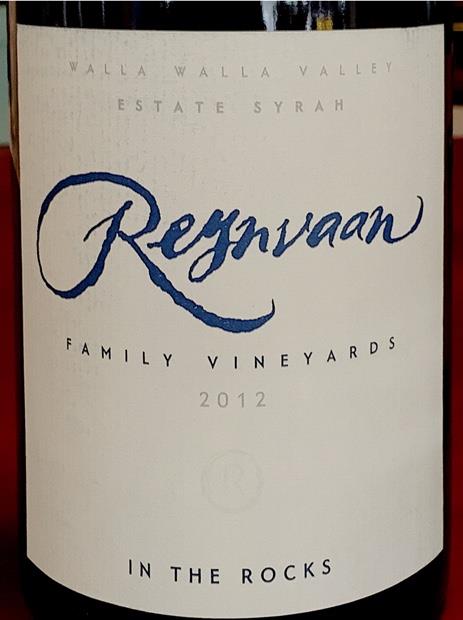
2012 Reynvaan Syrah In the Rocks

Reynvaan Pic


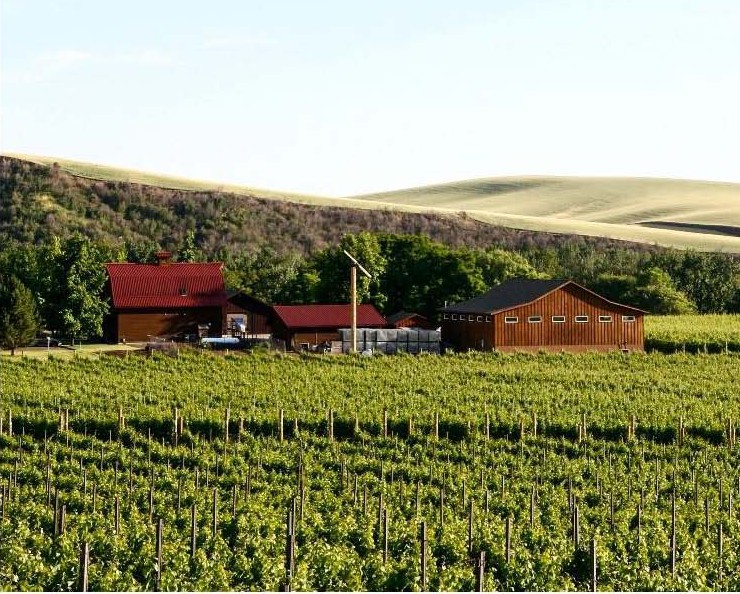
Reynvaan Family Vineyards – Walla Walla, Washington

Walla Walla Valley AVA

Wine Tasting Note

Do you enjoy Syrah from the Northern Rhone region? Cote Rotie AOC perhaps?

If you have enjoyed a quality bottle from the Northern Rhone and added it to your “wines of distinction” list (like I have) seek out a bottle of Reynvaan Syrah and experience a domestic producer that understands this style well. Everything about the Reynvaan wine speaks “Northern Rhone”… meatiness, earthy, floral. Many casual wine drinkers I have introduced to this style have had a difficult time wrapping their heads around it. My wife tasted this wine tonight and immediately said, “this is good… wait, I don’t think I like it.” This is that kind of wine – soft, supple, appealing… until the complexity shows on the palate… and you wonder, “is wine supposed to taste like this?”

Tasting this wine in the first hour after opening is a shame… the real wine doesn’t reveal itself and open until the 3rd and 4th hour. Tasting note after 4 hours open:

The nose carries strong raw meat aromas, with blackberry and mulberry fruit, floral violets and a touch of nail polish. The wine is fruit forward on the palate with blackberry and black currant, has a dark chocolate mid-palate and a floral violet with oily tar finish. After four hours, some of the freshness of the fruit is lost, but the classic Northern Rhone profile is revealed… that oily texture and tar finish. Wow, for 25% – 50% less than Cote Rotie, this wine can be acquired in the U.S. The wine has medium-high acidity, but only medium tannins. The lack of tannins throws the balance off a bit, but the plush, oily texture is right on. This is a well-made wine from a vineyard managed to produce fruit to match this style. The evolution of flavors and textures in the last four hours leads me to believe you should give this some time in the bottle to realize its true potential: peak drinking window 2017-2018. This is not a wine I would choose to experiment with for extended bottle aging.

Well done! If Matt Reynvaan could have squeezed a bit more tannins from the skins/stems, this would have been world class, at the absolute pinnacle of wines made in this style.

Comments Off on 2012 Reynvaan Syrah In the Rocks

Filed under Cool Climate Wine, Syrah/Shiraz, Walla Walla Valley, Wine Tasting, Wine Tasting Notes

A Tale of Two Red Cities

In the USA, Walla Walla Valley AVA is fast approaching premier status as a red wine producing region. The highest accolades are coming from Merlots and Syrahs, but the area produces well-made Bordeaux Blends too. From a critic’s perspective, this area is a serious alternative to the Napa Valley region… especially, if you prefer the Napa wines produced before the mid 90’s. Now, there is a choice between two premium “red” producing cities in the U.S.

The over-arching theme in Walla Walla is the pursuit of Old World styles of Cabernet Sauvignon, Merlot and Syrah. If you enjoy the popular New World style of heavily-oaked, fruity Cabs coming from Napa (like Caymus and Silver Oak) very few of these Walla Walla wines will find their way into your cellar. Syrah aside, I have chosen three of the oldest producers in Walla Walla as effective examples of the diverse styles of Bordeaux Blends that represent this growing region: Walla Walla Vintners, Seven Hills Winery and L’Ecole #41. I visited all three last month and was fortunate enough to do a deep-dive with each.

WWV Pic

Walla Walla Vintners

The flavor profile across all releases at Walla Walla Vintners (WWV) had the most dissimilar flavor profile in the area. I met with Bill Von Metzger the winemaker and we discussed the winery founded in 1995 in depth.  Their vineyards (and immediate neighboring sites) located at the Eastern edge of the valley contain the only dry-farmed vineyards I was able to find in this AVA. They originally prepared these estate vineyards for irrigation, but have yet to experience a growing season requiring the additional water. Although, if the Washington drought continues, they expect this may change next year. The WWV 2015 vintage validated once again the impact of dry-farming on my palate. All wines tasted tended to be more concentrated and textured, perhaps squeezing more out of the terroir.

Bill is a locally educated and trained winemaker. In my experience, this can be an impediment to good winemaking. Exposure to a broad sampling of world winemaking styles tends to develop better winemakers. Although in this case, Bill transcends his background… I think, primarily due to his keen curiosity and desire to experiment. I thought Bill showed a deft hand at pursuing the Napa Valley style… at half the price. Of my twenty (or so) tasting appointments in the area, this was the only winery embracing the challenge and successfully producing this style in a cooler Walla Walla climate.

If you enjoy Napa Cabs, try these wines. They may not quite reach the level of the premium Napa producers, but my goodness, not at $75+/btl either. The quality is good and the value is undeniable.

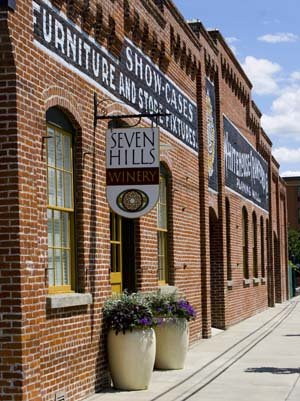
SHW pic

Seven Hills Winery

Seven Hills is the preeminent Old World French Bordeaux style producer in Walla Walla and one of the first wineries founded in the area in 1988. I met with Erik McLaughlin, an executive and manager at the winery. Erik and I discussed the history of wine growing in the region, their philosophy and the resulting growth. Seven Hills produces wines that compare very favorably to Bordeaux labels. All their wines have a lighter, sometimes silky texture with a good acidic and tannic backbone. Refined, balanced and built for aging, but approachable enough when young to be an excellent companion to a steak dinner. The tasting room is in a very urban setting at the winery, with the atmosphere from the 100+ year old building enhancing the tasting experience.

I talked briefly to Casey McLellan the winemaker and founder and I heard from both of them their total commitment to this wine style, regardless of the popularity of New World style California wines over the last decade. A great story and I believe a good business decision. These wines are some of the best of what I call “restaurant style” wines, made to accompany food and at the right price to be fairly affordable after the three tier distribution system delivers it.

If you enjoy red wines originating in Bordeaux France, try these wines. Again, these do not quite reach the level of premium Bordeaux producers, but comparable quality is sold at half the price (or less) of their Old World competitors.

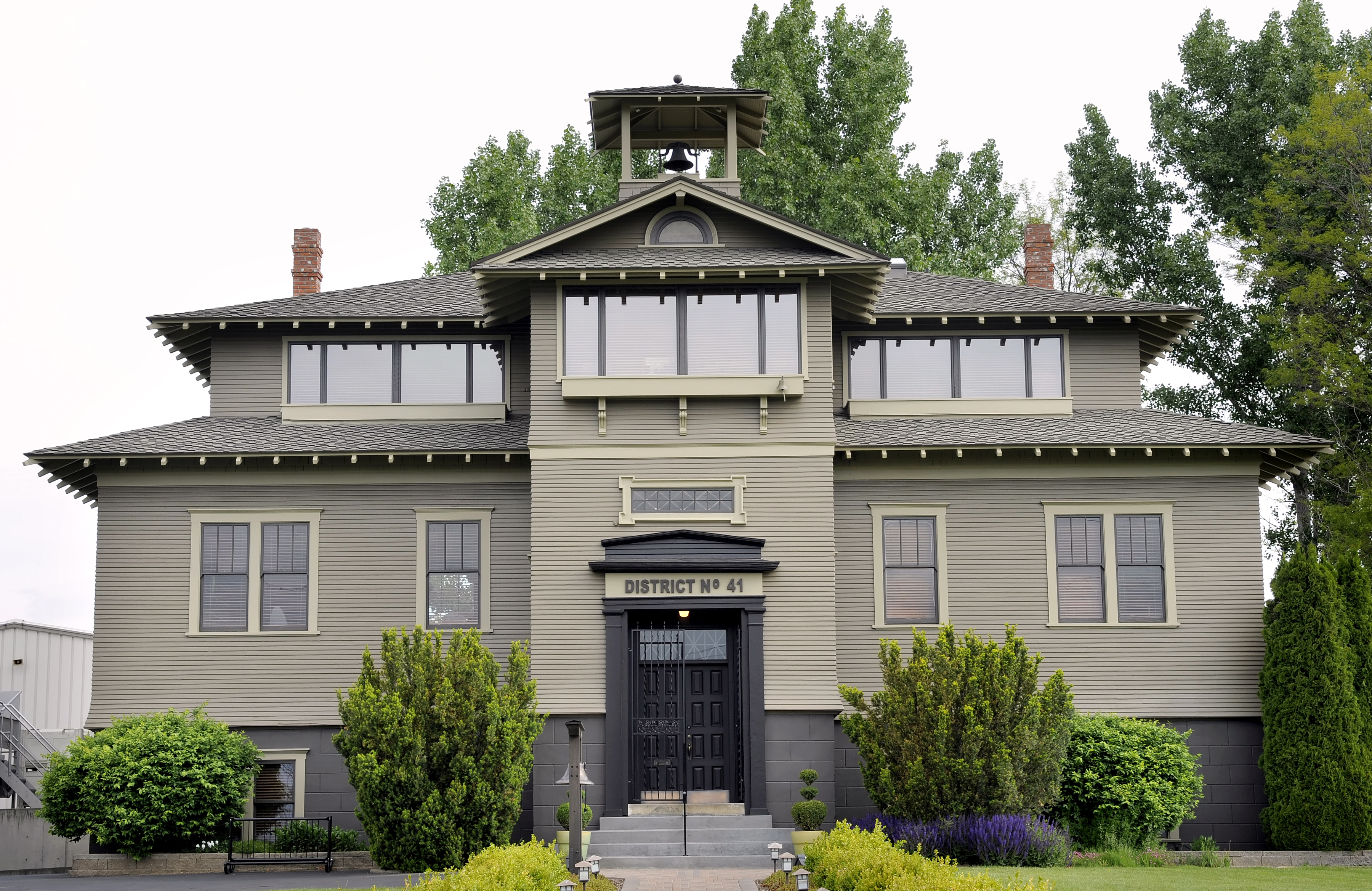
Schoolhouse photo

L’Ecole #41

L’Ecole is the most notable example of a winery in the region that best walks the fence between New & Old World styles. Founded in 1983 in an abandoned school house, they have grown substantially into a large commercial winery. I have been drinking their wines since the early 2000’s and do miss the hometown, small business atmosphere from those early days. Is it OK to be nostalgic for the old building facade, before the face lift? Then again, I also preferred the previous cute label too. Yes, (begrudgingly) I understand the idea – “Time and Tide stops for no man”. I met with Ben Dimitri the tasting room manager and we talked about L’Ecole history and past vintages.

It was interesting to discuss the story of the 2004 vintage in Walla Walla. It was the coldest growing season in memory for the area and few local vineyards were able to produce ripe fruit at harvest. 10+ years ago, Washington State was still a fledgling wine region and the largest producer in the state (Chateau St. Michelle) offered the early Walla Walla producers the opportunity to source fruit from their warmer Columbia Valley vineyard locations. What a generous and smart move…  missing a vintage in those early years would have seriously hurt the local industry and slowed their momentum in the market. The topic arose, because I mentioned enjoying a bottle of 2004 Ferguson (lost in my cellar somehow) last year. The bottle handled the 10 years of age well, but was at the outside edge of its drinking window.

If you enjoy red wines originating in Bordeaux France, but would prefer an easier drinking more approachable style… L’Ecole is your ticket. Once again, think half the price.

Diversity and Value

If you notice, there are two common themes here: diversity and value. Try these Walla Walla wines. If you are more than an occasional, casual wine drinker in particular, seek them out. These can easily become your choice for the value section of your cellar.

Wine Tourism

This area has a long way to go as a wine destination, but it was significantly more welcoming than my last visit seven years ago. Premier sous chefs around the country looking to venture out and start a premium cuisine restaurant, please consider Walla Walla. A well-run, properly promoted gourmet restaurant will succeed here, without the competition you would find in other top wine regions. Currently, the food is only slightly better than average, even at expensive establishments. With all the fresh fruit and veggies grown locally, this would be a perfect location for a farm-to-table concept. Producing world-class wines right in their backyard, Walla Walla has to be the next wine destination to hit the foodie scene. I look forward to my next visit and enjoying a much more vibrant restaurant scene.

Walla Walla Premium Bordeaux Style Producers

Leonetti Cellars and Woodward Canyon Winery are the two oldest wineries in the Walla Walla AVA. I have tasted their wines and they are excellent, but priced to match, or exceed their Bordeaux and Napa competitors. These wines are every bit as good, but I find it hard to see the value. Frankly, I would rather drink the established producers I know from Bordeaux and Napa, with much larger production and greater availability. This post was meant to highlight the value in Walla Walla. These producers do not fit into that category.

Comments Off on A Tale of Two Red Cities

Filed under Bordeaux/Meritage Blend, Cool Climate Wine, U.S. Wines by Region, Walla Walla Valley, Wine by Varietal, Wine Tasting, Wine Travel

Is a Trained Palate Necessary to Produce Fine Wine?

old-new world

Old World Wine Styles

I have been doing interviews and visiting with several Washington State wineries this week and the discussion struck a chord, providing an interesting personal realization… not all Owners, Winemakers and Growers have developed a broad understanding of world wine styles. Over the last several years writing about wine along the West Coast, I had assumed I was speaking with professionals that had all spent time developing  a palate and tasting styles from around the world. I now understand, this is not a formal requirement for a degree in Enology and the Somm training I received is really quite a different area of study. This week brought the issue to light for me and helped me to understand why being familiar with world wine styles can be an important element in producing quality premium wines.

There are very specific reasons why different Old World regions in France, Germany, Italy, Spain (etc.) have developed these famous regional styles. The obvious one is to produce wines that pair properly with local foods, but I wanted to explore one other in particular more carefully:

  • The 100’s of years of trial and error with local varietals, learning to accommodate local growing conditions and make the best wine possible.

This is the reason why the world views the best expression of Syrah to come from the Rhone, or the best expression of Nebbiolo from Barolo / Barbaresco, Chenin Blanc from Vouvray, Riesling from the Mosel, etc. These varietals have been produced in these regions for generations and for the wine enthusiasts out there who have not taken the time to explore them, start now! Your imagination will be awakened and you will discover whole new horizons you never realized existed. (back on topic though) Take a minute to think about how this issue should impact domestic wine production… you can present the argument that New World wineries are pioneers, working in new regions and developing their own unique styles, but since when is this done in a vacuum?

The best analogy is fine cuisine. Chefs travel all over the world to taste different styles and then return to the U.S. to introduce what the industry calls “fusion” cuisine. These chefs forge entirely new dishes by taking classic styles from around the world and “fusing” them to create new, unique dishes all their own. Understanding the “classic” wine styles of the world is equally as important… to compare and contrast how our New World terroir can be the same, or different, and to blend the best of both worlds to achieve the best expression from each of our domestic wine regions.

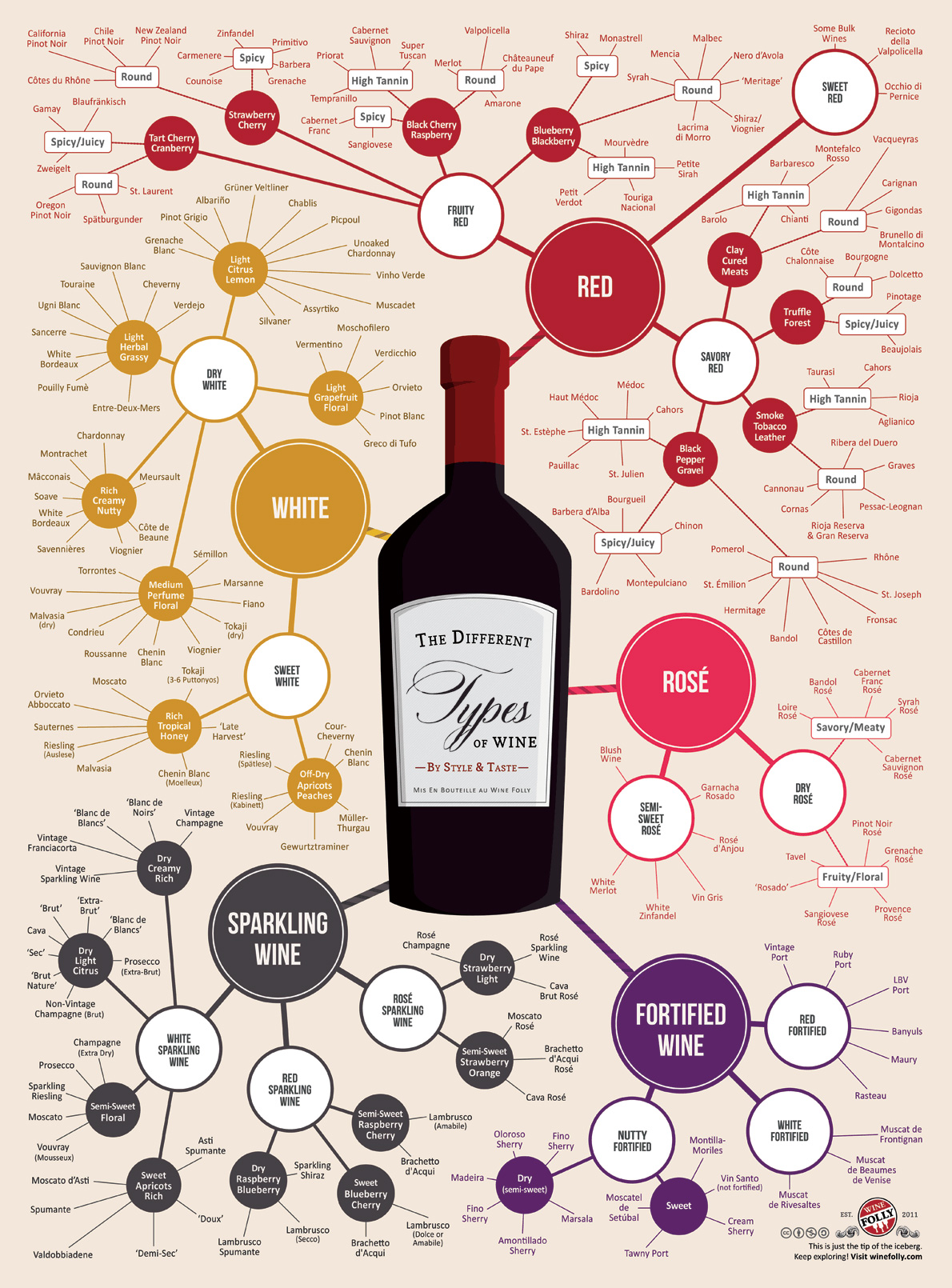
the-different-types-of-wine-by-style-and-taste

Is Wine Style Important?

Having interviewed quite a few winemakers over the last couple of years, I have come to understand how important wine style really is. Having a working understanding of tasting fruit in the field and selecting a style of wine that best complements that vintage is critical to producing a quality product. I tasted a Mosel style Riesling on this Washington trip from a winemaker who obviously understood how that should taste and how to achieve it. Has he traveled to the Mosel and studied with winemakers in the region? No. Does this winemaker have a large cellar, a trained palate and have regular exposure to taste aged wines from around the world? Yes.

Terroir Influence

The new Rocks AVA here was made famous by Christophe Baron and his Cayuse label. He persevered through the jeers and disbelief of local winemakers when he planted these vineyards, because he recognized enough similarities between this appellation and the Northern Rhone region to fuel his certainty that this area would produce world class wine. The local industry has come around to his thinking slowly, but the results have been hard to ignore. Tasting other local wines from this AVA, it strikes me as amazing that some of these wineries are not producing wines that express the interesting terroir of this place. Why else make wine here? I wonder, have they not taken the time to train their palates to recognize the Northern Rhone profile this area can produce? Or, is it they haven’t taken the time to research the winemaking techniques that can help to achieve it? Or, will it require the generations of wine experience (like in Europe) to realize it fully? On the other hand, maybe it is a simple lack of belief that this style of wine can sell out every year… Most of these Rocks AVA Syrah’s have a funky, meaty background that enhances the rich fruit-forward character of the wine. I realize this is not for everyone, but I would venture to say, a small AVA like this could never produce enough of this style of wine to exceed the world-wide demand for it.

Conclusion

I am thoroughly convinced, having a winemaker with a BS in Enology is not enough alone to make premium wines. All the involved parties (Owners, Growers, Winemakers) should be able to taste the impact of regional vineyard management and winemaking techniques in the wine. Tasting that impact is a start. It can help to hone a palate. The next critical step is the commitment to study and compare similar wines produced in their classic region of origin. Each and every vintage (warm, cold, or moderate year) has to start in the vineyard tasting the fruit and fine-tuning the vision for the style of wine that will be made. The revelation here is:

  • To make premium wine, it requires more than just enthusiastic commitment to its production. You must have a passion for its consumption!

3 Comments

Filed under Wine Education, Wine Industry, Wine Tasting, Wine Travel

Differentiating the Premium #Wine Category

(Ongoing series of posts regarding Walla Walla AVA wine tour)

Unfortunately, I hurt my knee on this trip and had to visit the local walk-in clinic today, but it turned into an interesting experience. The attending doctor was a big wine enthusiast and he said something that resonated for me, “a winery can’t just say it is an ultra-premium winery, they have to earn it!” Can a winery just raise its price and call their wine ‘ultra-premium”? Is it possible to get away with this as a marketing strategy?

Wine_preference

My wife and I visited Va Piano Vineyards today, a next door neighbor to Pepper Bridge Winery (a well-known ultra-premium cab producer). First we were presented with two single vineyard estate Cab Sauv’s (Va Piano & Octave Estate Vineyards) that were only available through their wine club – establishing a $60-$70 price point. These were $40-$50 in real value (IMO), in comparison with other growing regions. They were reasonably well-made wines, but a touch watery, had limited mouth-feel and a weak finish. So, here I am thinking, if you can establish that higher price point to begin your reserve wine offering, when you pour the really good stuff at the end, it will invite an unfair comparison… Guess what? The last wine (De Bruhl Vineyard Cab) was a beautiful wine and the retail price was $95/btl! Unfortunately, I can buy a similar beautiful Cab in Napa for $75/btl. As a counterpoint, we drove down the street to Sleight of Hand Cellars and they were selling Bordeaux Blends WITH a nice classic structure for $40-50/btl. Definitely more rustic than the Va Piano, but complete, balanced wines. A different style, but well made also and close enough in quality to make you sit back and wonder…

So, what is going on here? Just because a wine is more expensive, is it better quality? Not even close! The concept at work here is not as simple as poor value… it is “buyer beware” thinking. Instead of comparing the less expensive Va Piano cab to their more expensive, an educated consumer should be comparing wines to other producers in the same price category. I came to Walla Walla AVA looking to understand the region and part of that process has to be an evaluation of how the “value” compares with other wine producing areas.

Quality

I am torn on this topic. I can see both sides of this argument and I realize I am being a little unfair appearing to make an evaluation based on tasting at two wineries, but the issue is much more broadly relevant and does deserve more discussion. Smart marketing (pricing strategy) exhibits a savvy that I can appreciate in business, but as a consumer… it makes me slightly distrustful of the producer. Let’s say, I am interested enough in these wines to take advantage of their limited availability now. That question of realistic value will always be running through my head, when evaluating my next purchase from this producer… Not the kind of relationship I would want with a preferred winery.

As a consumer, how do YOU establish the price points you are willing to pay for various styles of wine? Without an experienced palate, this question is difficult to answer and the reason so-called “ultra-premium” wineries can develop traction with the buyer through perceived exclusivity. For a formally trained Sommelier, the answer is easier and I have introduced most of these criteria in my last post, but here it is again, and more…

  • Balance, balance, balance! Did I say balance? (enough emphasis?)
  • Structure… (sparing the emphasis 🙂 ): Acidity, Tannins, Texture (mouth-feel), Phenolic Development and a long Finish
  • Complexity: Layered flavors – separation between the Attack, Mid-Palate and Finish. Intriguing flavors – for example, minerality, herbal (i.e. mint), or floral notes. Quality of Tannins – fine, coarse, etc.
  • For individual buyers, value can even represent something as simple you prefer cinnamon, floral violet, or vanilla flavors and you are willing to pay a premium for your preference…

I had several comments relating to this topic in response to my last post and all emphasized the idea that expensive wines ($40/btl and above) had do be properly balanced and structured. What makes a wine worth more to you?

Comments Off on Differentiating the Premium #Wine Category

Filed under Wine Education, Wine Industry, Wine Tasting

Making #Wines to Drink Now, or Cellar?

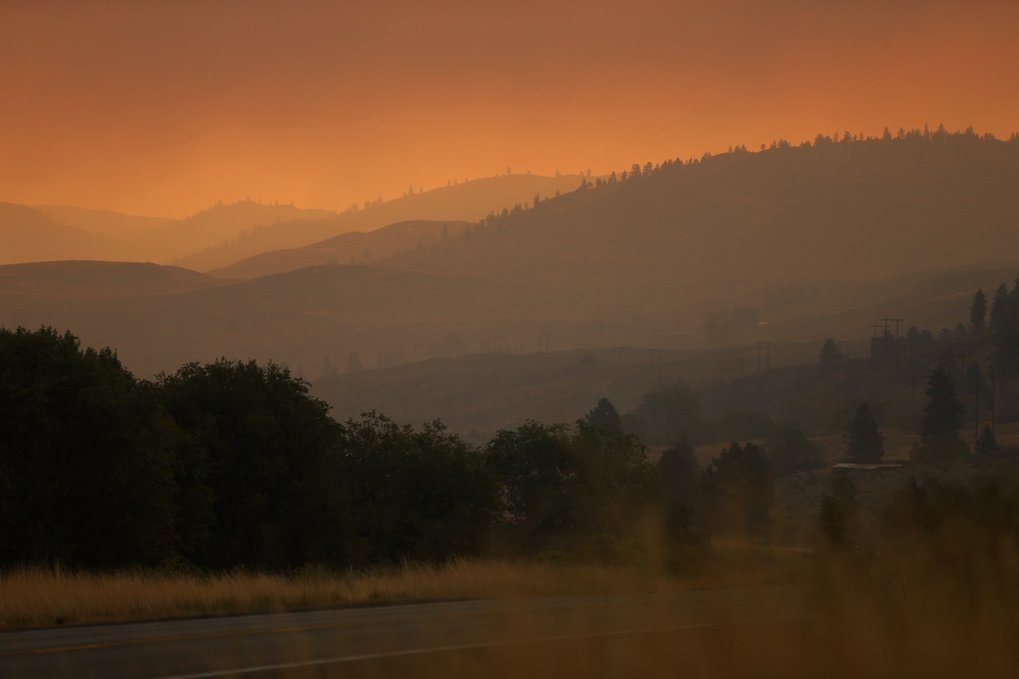
The sun barely illuminates the land under a thick fog of red smoke as seen from Highway 97 just south of Okanogan Friday August 21, 2015.

What a crazy week to have scheduled a wine tasting adventure in Washington State! Forest fires everywhere! The entire state is one big campfire… Flying into Spokane, we descended through a wall of billowing smoke. Driving down to Walla Walla the smoke cleared somewhat.

Later this week, my wife and I will be joining trade tastings and interviewing winemakers, but today we wanted to relax and stop at a couple of wineries of interest – as wine tourists. We stopped in first at K Vintners and then Five Star Cellars today and two interesting questions came to light: (tasting notes coming in future posts)

  1. Should winemakers be producing wine to drink now, versus wines to bottle age?
  2. Does making wine specifically to be drunk with food play well in the broader U.S. market?

I will tackle the first question now and the second in a follow-up piece.

Drink Now?

I was floored today. These were two respected Walla Walla producers recognized by critics and neither was focusing on structured wines more capable of aging in your cellar.

K Vintners

After one tasting experience, I am quite sure I could recognize any of their wines blind. This is not meant to suggest I did not enjoy a few of these wines, but more to emphasize their singular dimension. All of the wines are quite clearly made in a single style, utilizing similar techniques: noticeable French oak, high to very high acidity, very light and a minimum of mouth-feel, minimal finish, low to medium tannins and fruit forward.

Five Star Cellars

We tasted two vintages of their flagship wine, a Bordeaux blend called “Stellar”. The 2008 was good, showing high acidity, medium tannins and a palate of plum, blackberry, apple pie spice, graphite and touch of earthy minerality… but the 2009 was so much better, similar to the 2008 – but adding higher tannins and a fuller mouth-feel. The owner David Huse actually apologized for the additional structure. After a few minutes of conversation, it was obvious he believed their goal was to make easy drinking wines and that 2009 just didn’t fit into that focus.

Price Point, Wine Quality and Structure

I get it. Wineries have to sell their wine and in case you haven’t seen the numbers, somewhere between (depending on the study) 80 to 95% of all wines purchased in the U.S. are drunk within a week of purchase. Since we are throwing out statistics, how about this:  90% of all bottles purchased in the U.S. cost less than $12 USD. The wines we were tasting today all retailed for $40-$70/btl. Where am I going with this? Are these wineries correct in thinking that the majority of wine drinkers spending over $12/btl. want drink now, easy drinking wines? I have spent the last 20 years listening to feedback from wine enthusiasts and while very few are looking for the other end of the spectrum – rustic, cheap Chianti style wines, MOST do prefer red wines with good structure. How else could Napa Valley be able to sell so much Cabernet Sauvignon at an average price of $64.77/btl (2014 Wines & Vines) direct-to-consumer? It is certainly not because these wines are easy drinkers!

Winemaker’s View?

So how does the winemaker feel about this issue? I ask this question during interviews all the time. The answer too often is: “business sometimes dictates we make a wine for broad appeal”. At some wineries, this discussion is a non-issue. The winemaker makes a wine profile focused on quality in the classic sense and they find their market. Others I have interviewed, spend time with their customers and really understand the product their clientele wants… and then there are those that “think” they know what the average consumer wants. The perceived pressure to produce easy drinking wines in the U.S. is huge. For large volume wineries over 50,000 cases of production this discussion is irrelevant, but for the 60% of wineries in the U.S. that produce less than 5,000 cases, it is THE discussion to have. There is a place for all styles of wine in the market. My surprise came from visiting recognized, critically acclaimed wineries with this kind of thinking.

Wolf howling

Howling at the Moon!

If there is one thing I can definitively take exception to in the industry, it is this idea that wine enthusiasts (spending more than $12/btl) want flavor in red wines and don’t care about structure. Okay, I agree there are not many folks like me in the U.S. who will maintain a large enough cellar to buy young structured red wines and regularly drink 5-10 year old vintages. At the risk of boring readers by saying this again: STRUCTURE is what differentiates good wine! Red wine can taste like black, red, or blue fruit, have earthy minerality, or even exotic flavors like tobacco and tar, but these matter little without the primary structural components: Acidity, Alcohol, Tannins, Phenolic Development, Mouth-Feel (texture) and Balance. When wines are missing any of these elements, they can be unpleasant to drink, or more commonly – just boring.

Tasting note for the Five Star Cellars 2009 Stellar (Bordeaux Blend) that was supposedly not as “good” as the 2008:

The nose hints at the level of extraction with blackberry, plum and currant fruits, a touch of alcohol, fresh tobacco and earth. The palate follows with a dense fruit-forward attack that is very lively in the mouth, with high acidity and high tannins.  The vanilla comes through from the oak, but doesn’t overpower. The tannins have a plush, granular texture producing a big mouth-filling wine with a very long finish. This wine is fast approaching its optimal drinking window of 2016-2018. It is only missing a defined mid-palate… a 91 score without. This would have earned a 94-95 score with more complexity.

A grand effort by a small Washington State winery. I sincerely hope they change their focus to making more wines like this…

1 Comment

Filed under Bordeaux/Meritage Blend, Walla Walla Valley, Wine by Varietal, Wine Cellar, Wine Collecting, Wine Education, Wine Industry, Wine Tasting, Wine Tasting Notes

Why Do #Wines Taste Different? Part 2d – Vineyard Management

Vineyard Management

'We only produced 50 cases this year. Most of our competitors spill more than that.'

The effects of Vineyard Management are critically important, but not always easy to recognize. They usually impact wine structure: Acidity, Tannins, Alcohol, Complexity, Phenolic Development and Mouth-Feel. Choosing one practice, over another… often has little to do with science. A limited amount of empirical scientific data is available on this topic and terroir differences often demand widely different approaches. It is difficult to settle on universal best practices. These are the reasons wineries often depend on individuals with extensive experience in the local region. Does implementing these ideas have a direct observable connection to quality? Perhaps yes… at the very least, these ideas can impact the character of wine from individual vineyards. Here is a very recognizable example:

Pergola_Vineyard     (Pergola Trained)

Guyot trained 1     (Guyot Trained)

Italian producers have been converting old pergola style trellising (photos above) to head-trained systems (i.e guyot). This has been a major factor in the on-going improvement in consistent quality across Italian vintages. Head-trained vines make it much easier to employ pruning strategies throughout the growing season. A major factor in accommodating annual climate variation.

Harvest Yield Management

Vineyard managers typically have experience with enough harvest variation to get a feel for the tonnage of quality fruit their vineyards can produce. Too big a yield, and the vines don’t seem to focus on producing concentrated flavors and complexity. Too small a yield and the vineyard is not financially viable to farm. In some locations, the government dictates the yield, if the winery wants to put the appellation name on the label. Yield is a reasonable indicator of basic quality. Anything over 4 tons per acre will be approaching bulk wine territory. Most premium wineries drop anywhere from a quarter to half the berries in the field every year.

Soil Supplementation

Fertilization and soil prep is a scary idea in a vineyard. Grape vines are highly efficient at growing successfully in very poor conditions, so any small change tends to have a big impact. The idea here is NOT for the vines to grow more vigorously. The optimum conditions desired for increasing harvest yield is the exact opposite of what is desired. Although, soil prep before planting vines is very common and usually deals with soil pH and plant metabolism. For example, in many wine growing areas in Arizona, it is critical that calcium carbonate and/or magnesium carbonate be mixed into the soil. So called “liming” of the soil is a vineyard tradition that has been practiced for hundreds of years. Higher pH soils tend to add acidity to the fruit, a critical component in quality wines.

vine-rows

Pruning Strategies and Row Orientation

This approach is more recent. Canopy management as a criteria for producing quality fruit is a strategy that requires a significant amount of pruning labor (high cost) and therefore is mostly employed in the premium and ultra-premium wine categories. A few years ago, I interviewed Jim Duane, winemaker and vineyard manager at Seavey Vineyards in Napa Valley. With a BS in Biology and a focus on botany, he spoke passionately about meticulously pruning the vines and modifying the canopy to match each vintage’s growing conditions. The row direction decision is now made based on optimizing drainage and improving direct sun availability. Vineyards planted on relatively flat acreage in the last 20 years are almost always planted with North-South facing rows to maximize consistent sun exposure. The vineyard in the photo above is planted down the rise and is unusual in recent times. Rows today are usually planted across the rise to facilitate optimal drainage. These ideas have become common practice in the U.S., although not as pervasive in Europe.

Harvest Strategies

Single pass harvesting is the standard in the industry, but in the premium and ultra-premium category that is changing. Paloma Vineyard is an estate winery in Napa Valley that takes this idea to the extreme. Harvesting over extended periods of time, tracking rows and blocks for ripeness, or desired character. They have planted different clones of Merlot and vary the harvest timing as necessary for each. In addition, they bring in blocks early to improve structure and others later to enhance flavors. This is very labor intensive and must be a challenge to manage every year… but the results  are hard to argue with… Paloma achieved a Wine Spectator #1 wine in the world rating in 2003 and regularly earns 95-100 scores every vintage. By the way, if you are lucky enough to catch a visit with the owner Barbara, you will get an in-depth peak into the life of a winemaker as farmer and the lifestyle that comes along with it!

Gobelet vineyard

Trellising

This is an Old World versus New World discussion. Many vineyards are still planted and grown the old traditional ways in Europe, i.e. Pergola (Italy), Gobelet (Spain), etc. I have seen 75 – 100 year old Zinfandel vines in Sonoma County trained in the Gobelet method. See a photo of a Gobelet trained vineyard in Spain above. These Old World style methods make no sense to me for fine wine. Head training (Guyot method & similar) clearly provides better opportunity to employ detailed pruning strategies. Oh well, I am sure THAT will start an argument with a winery in Europe somewhere…

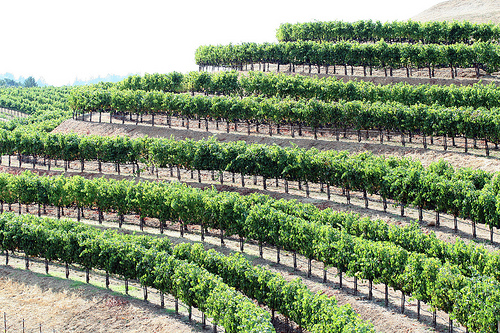
Spring Mtn Vineyard

Terra-Forming, Terracing and Vine Spacing

I love the photo from Pride Mountain Vineyards above… Let me describe why this vineyard is so different:

This is a terra-formed terraced vineyard with a double row planting across the rise and a tight vine spacing layout. The vines in the front of the row produce riper fruit. Those in the back struggle and the fruit is more austere and structured. Everything in a Bordeaux varietal vineyard you could ever want, all in one place. This vineyard produces amazing wine. I doubt many vineyard owners would go to the expense of preparing a vineyard site this way.

Irrigation and Dry Farming

This is another one that will get me in trouble… This is one idea where I agree with the Old World thinking. In my experience, having tasted thousands of wines… There is a noticeable difference in wines from dry-farmed fruit versus irrigated. Why is there a difference? Is there verifiable science behind it? Not likely, but if I were to guess… dry-farmed vines struggle more, the roots drive deeper into the earth and build additional complexity in the wine?

The End

I have had quite enough of what has turned into a very lengthy discussion. There were literally too many contributing factors affecting wine flavors and structure to even scratch the surface in these few pieces. I hope the examples provided and the recommendations offered made the information a little less dry and I apologize to the Old World Wineries in advance for representing their growing regions poorly. I just haven’t interviewed enough European winemakers to understand their local wine growing practices in this kind of detail. It is my hope to rectify that someday 🙂 Anyone interested in subsidizing an old Sommelier to make a trip (or two) over to wineries in Europe? Strictly in the interest of discovery and wine research to educate a U.S. wine industry thirsting for knowledge…

Comments Off on Why Do #Wines Taste Different? Part 2d – Vineyard Management

Filed under Wine Education, Wine Industry, Wine Tasting, Wine Travel

Why Do Wines Taste Different? – Part 2c: Soil Types

“Voodoo Magic” in Wine?

Voodoo Juice

(Unrelated Copyrighted Trademark used to illustrate the idea)

Winemaking can be complex chemistry, artistic expression, or a mixture of the two, depending on the winery. That first “science-based” option is certainly the most accessible and also the reason so many winemakers have chemistry degrees. This approach (topic of the first piece in this series) utilizes empirical processes that have a direct, identifiable impact on the wine. Climate (topic of the previous piece in this series)  is another easy to recognize factor when tasting wine (with training), but these last two pieces in the series are about the “voodoo” in the wine: soil type and  vineyard management. I doubt many consumers would recognize the importance of this topic and most high-production bulk wineries rarely care, but for an estate winery under 50,000 cases of production… it is the key to differentiating an individual wine label . That is why you see so much maneuvering in the U.S. to establish new AVA’s (American Viticultural Areas). Winery owners are trying to attach special significance to the fruit source (vineyard location). Developing a unique wine profile is critical to marketing strategies for these producers. As a consumer, I am usually only interested in the “voodoo”, if I have visited that vineyard at the estate. Analysis of soil and vineyard management is just too dry a topic to review without some sort of personal connection. Does the appellation factor into your choice in wine? Do you look for “Rutherford”, or “Margaux” on the label, before you select your Cabernet Sauvignon/blend?

Soil Types

I am reasonably sure no one is interested in a chemistry primer on soil composition, so I will try to move this discussion towards general soil categories. These vineyard site characteristics can have recognizable effects on quality and flavor. Let’s bypass mineral composition and move directly to key factors affecting the vines. There are many different vineyard soil types: Silt, Sand, Loam, Clay, Gravel, etc. There are even more specific sub-types: Calcareous, Schist, Shale, etc. Although, these soils all have just a few tangible characteristics that have well-known effects on the vines.

Water Drainage and Free Organic Matter – Soils that do not drain well, or are too fertile produce horrible wine. When vines grow vigorously, the berries are larger, the juice after press is less concentrated and the resulting wine is one dimensional. Examples: Poor Soil – Loam, Silt. Better Soil – Gravel, Sand.

Soil pH – Basic soil (higher pH) is the key here – think regions like Champagne, Loire, West Paso Robles and other locations with calcareous soils high in calcium carbonate. All the anecdotal evidence for this shows basic soils produce acidic wine – a key component to the structure of quality wine. I won’t bore you with the theoretical chemistry, but evidence seems to confirm this idea. Better Soils – Calcareous, Chalk, Marl.

Soil Depth – An impermeable layer should not be less than 40″ below the surface for dry-farming of the vines (dry-farming should be the goal).

Water Retention – This may sound contradictory, but the best vineyard sites have both good drainage at the site AND good water retention in the soil. These characteristics exist and are excellent for dry-farming vineyards (no irrigation).

Varietal Soil Preferences

Interestingly, when specific varietals are grown in an area over long periods of time (decades+) successfully, the vines seem to adapt to the terroir. This optimization has never been formally studied, but general observations abound in the world wine community supporting this idea. Currently, vineyard root stock for each varietal is available in many slightly different clone options adapted to different climatic and soil conditions. The growers choice of which clone to plant can be a make, or break business decision. Areas like Burgundy, where Pinot Noir has been grown for more than 500 years, have allowed the vines to adapt naturally and you can tell the difference in quality.

Grape varietals often have their own soil preferences:

  • Cabernet Sauvignon produces the best wine when grown in Gravel and Volcanic soils.
  • Merlot produces the best wine when grown in Sandy Clay.
  • Chardonnay and Pinot Noir produces the best wine when grown in Chalky soils.

Some varietals seem to do well in many different soil types, but manifest radically different flavors:

  • Sauvignon Blanc has tropical fruit flavors when produced in Marlborough (New Zealand) and lemon and/or grapefruit flavors when produced in Napa Valley (California).
  • Zinfandel tends toward Strawberry flavors when from Dry Creek (Sonoma County), but can have strong jammy blackberry and blueberry notes when produced in West Paso Robles (Central California Coast).

Vineyard - Larkmead Vineyards

Estate Wineries Embracing Vineyard Variation

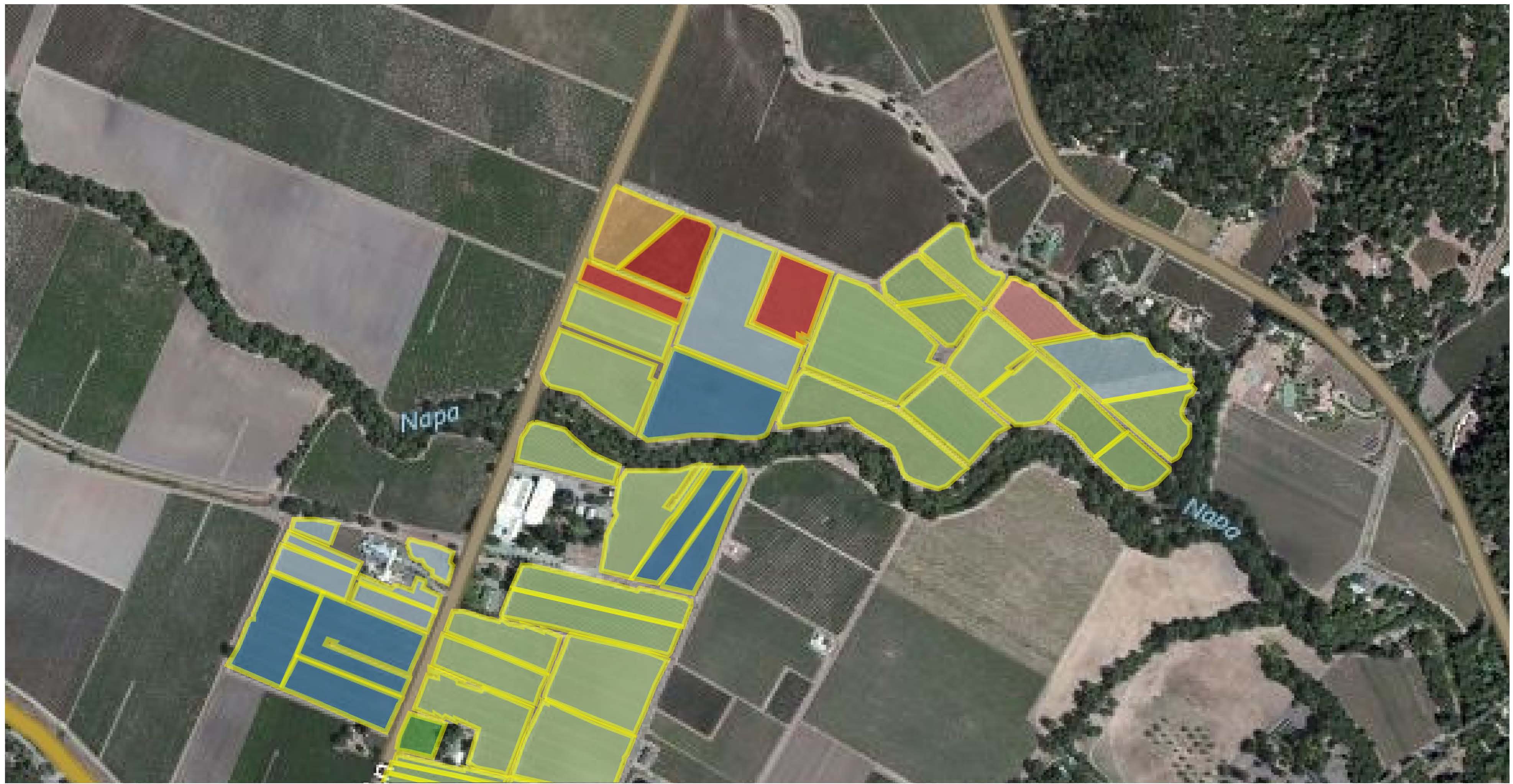
A few years ago the head winemaker Dan Petroski at Larkmead Vineyards offered the best explanation I have heard for optimization of variable growing conditions at a single vineyard site. In recent years, Larkmead has invested heavily in their belief that soils and micro-terroir make a difference in the quality of the wine. Their estate vineyards (108 acres planted) have been separated into 40+ separate vineyard blocks, some quite small (against typical industry thinking). Some of these vineyard sections were re-planted to change row direction and take advantage of improved sun orientation and drainage characteristics. The blocks were separated based on soil testing and observation to define clearly different growing conditions. Where this gets really interesting is their further investment in numerous smaller stainless steel fermentation tanks. For those who say terroir impact on wine is a fallacy, they need to taste the lot to lot differences side-by-side at an estate winery using this vineyard strategy. This system of wine production allows the winemaker to take advantage of distinctly different wines and offer them as separately bottled vineyard designate releases, or blend the individual blocks to achieve a better, more complex product.

My Previous Recommendations

Now, let’s put this information to use (remember the “voodoo”). In past pieces, I have suggested that certain growing regions tend to generally produce better quality over-all. Let’s explore a few reasons why…

Valley Floors (in the flood plain) – These locations tend to have a high percentage of silt, but not always. For example, the right bank of the Garonne River in Bordeaux has sandy clay soil (premier Merlot region in the world). Putting aside complex locations like Bordeaux and speaking in generalities, valley floor locations produce simpler wines that often are missing structure… especially when grown in warm climates, examples: Puglia, Italy or Inland Valleys, California. There are some interesting exceptions though. Certain varietals (like Tempranillo) can grow in these locations (i.e. Ribero del Duero) and thrive, but I would be careful if you are searching out quality. Know your varietals and their optimal growing regions, unless you are comfortable experimenting with hit, or miss results.

Mountain/Hill Sides – These locations tend to be virtually barren, with well-drained schist, slate, granitic (etc.) topsoils. In many cases, wine grapes are the only crop these soils can support. Again, this seems contradictory, but these regions can offer perfect conditions for many different wine grape varietals. Examples of Mountain/Hill type optimal growing regions: Syrah – Northern Rhone, Nebbiolo – Barolo, Riesling – Mosel, Cabernet Sauvignon – Spring Mountain.

Examples of a few optimal growing regions by varietal: Cabernet Sauvignon – Napa Valley, Left Bank Bordeaux; Merlot – Right Bank Bordeaux, Spring Mountain; Pinot Noir – Burgundy, Willamette Valley; Syrah – Rhone Valley, Barossa Valley; Malbec – Mendoza, Riesling – Mosel, Chenin Blanc – Loire Valley, Swartland, Stellenbosch.

Magic-pot-witchcraft

The Voodoo

No one really knows for sure what specific chemical composition is changed due to these soil factors. Neither is it known the process by which these soils change the character of the wine, but I can tell you, a trained palate can taste wine blind and describe the type of terroir it originates from.

Next…

Is this topic never-ending? Yes! The potential for exploring variability in wine character is quite literally endless. Although, I will endeavor to finish this series in my next piece with an evaluation of Vineyard Management and its impact on wine.

3 Comments

Filed under Wine Collecting, Wine Education, Wine Industry, Wine Tasting, Wine Travel

Why Do Wines Taste Different? – Part 2b: Vineyard Location

Vineyard Influence on Wine Flavors and Structure

As I dive deeper into this, the rabbit hole takes me deeper and deeper… I must apologize again. Location is too big a topic to include a discussion of soil types in the same piece… So, it appears I will have a part 2a, 2b and 2c in this series on “Why Wines Taste Different”. For those of you staying with me on this, thanks for your patience and perseverance.

Vineyard Location

Varietals

This topic has everything to do with the individual varietal. If you want to find the best wines, a big part of the answer is in the vineyard location. Learning to differentiate the common warm climate varietals from the cool climate varietals is important:

Cabernet-Sauvignon-Grapes

(Cabernet Sauvignon Grapes)

Warm Climate Reds 

Grenache, Mourvedre, Cabernet Sauvignon, Syrah, Tempranillo, Zinfandel, Malbec, Merlot, Sangiovese

Viognier grapes

(Viognier Grapes)

Warm Climate Whites

Viognier, Roussanne, Marsanne. Chardonnay, Sauvignon Blanc

Pinot noir Grapes

(Pinot Noir Grapes)

Cool Climate Reds

Pinot Noir, Cabernet Franc, Syrah, Nebbiolo, Merlot

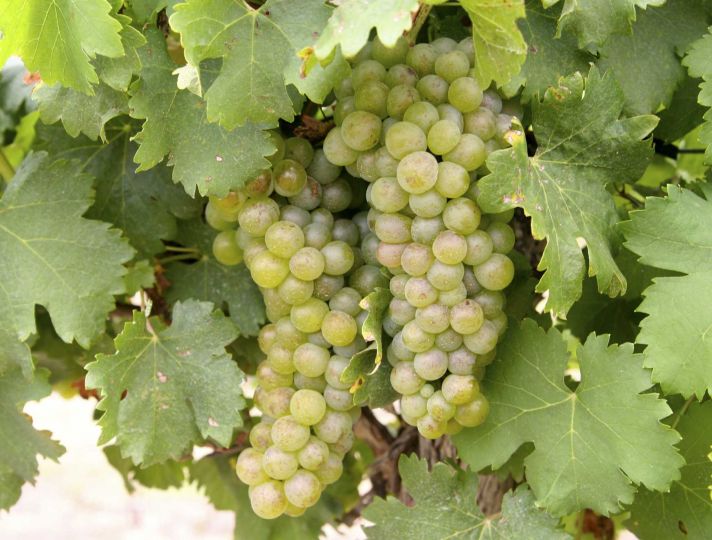
riesling-wine-grapes

(Riesling Grapes)

Cool Climate Whites

Chenin Blanc, Riesling, Sauvignon Blanc, Albarino, Pinot Gris, Glera, Chardonnay, Gewurtztraminer

Climate Affect on Wine Character

There are many more varietals in each category, but these are frequently seen in single varietal formats and are the most common. Notice that Chardonnay, Sauvignon Blanc, Merlot and Syrah are listed as both. These four are the most versatile wine varietals in the world. They can make quality wines in both warm and cool climates, but keep in mind the flavors and textures are totally different when grown in the different locations. Warm climate Merlot has less acidity/tannins and can be beautifully soft, or horribly flabby. Warm climate Chardonnay usually has less acidity and tends towards simple citrus flavors. Most warm climate Sauv Blanc tastes like fresh mown grass mixed with lemonade to me, but others enjoy it. Warm climate Syrah is another story… warm climate locations are better when moderated by a Mediterranean climate, but these areas can produce killer wines. Cool Climate locations can produce exceptionally complex Syrah, but sometimes are a little weak on fruit flavors, so are often mixed with Viognier to enhance approachability. I enjoy these wines tremendously.

What to Look For?

Spring Mtn Vineyard

(Spring Mountain Vineyard)

Inland Locations at Higher Elevation

(roughly 2,000-4,000 feet)

For example, try the top of Spring Mountain AVA and Howell Mountain AVA in Napa Valley. You will find bold wines with a pleasant blend of acidity, tannins and alcohol there. In the hands of an expert winemaker, these vineyards can produce a wonderful, fully developed mid-palate. Haven’t heard the terms “attack”, “mid-palate”, or “finish”? Drop me a line and I will write a piece explaining these wine characteristics!

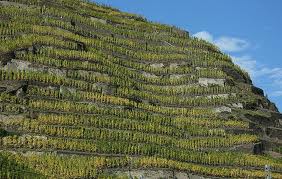
Mosel Vineyard

(Mosel Vineyard)

Steep Vineyard Sites

These sites stress the vines and drain them very effectively. The berries are usually smaller and the fruit (and resulting wines) always have more intense flavors. These vineyards are everywhere, just keep an eye out. The opposite holds true, be careful with wines made from valley floor fruit. If not managed carefully, these vineyards can become bulk wine territory! The most extreme examples lie in the Mosel Region in Germany.

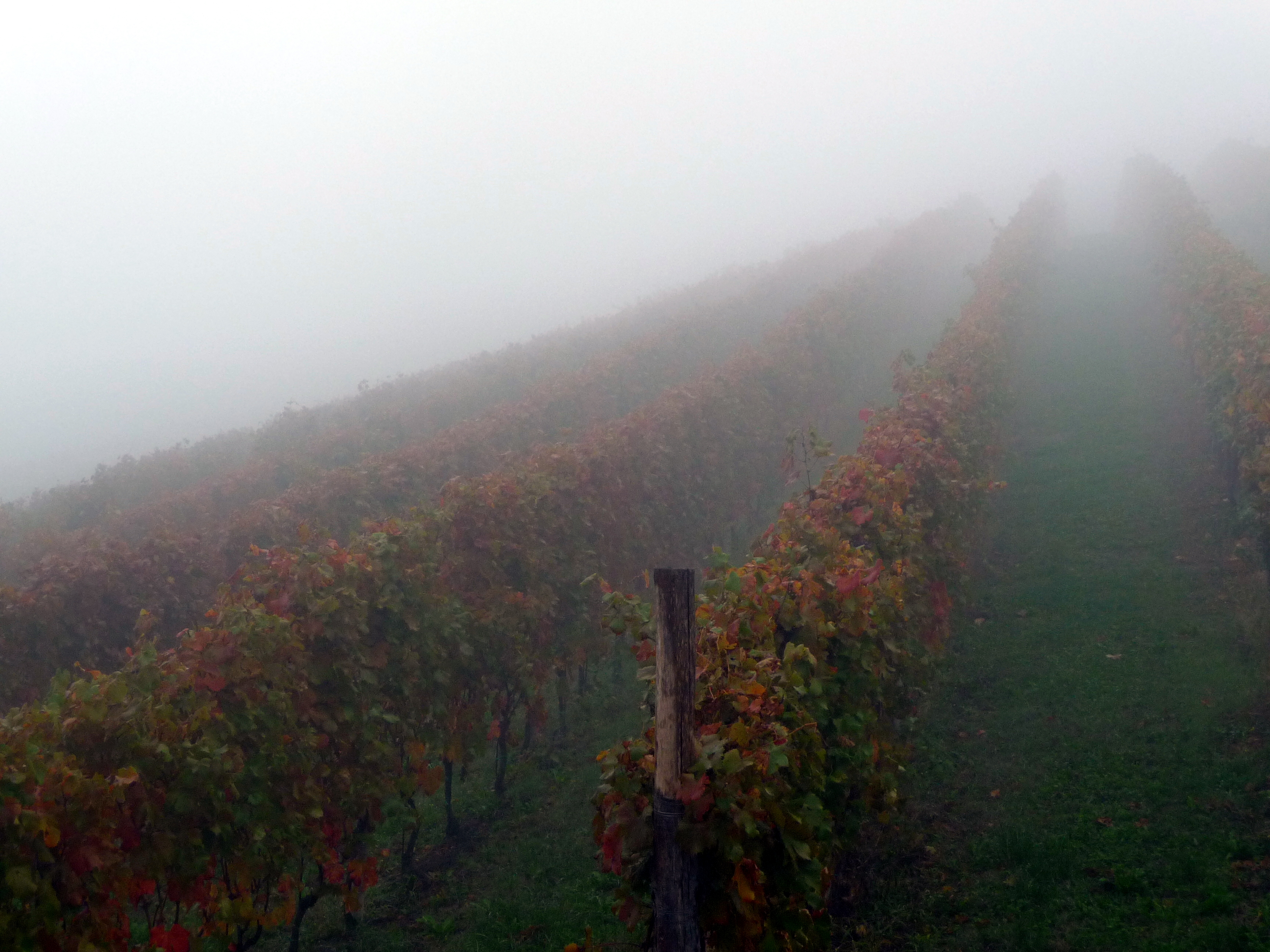
Langhe_vineyard

(Langhe Vineyard)

Inland Foggy Locations

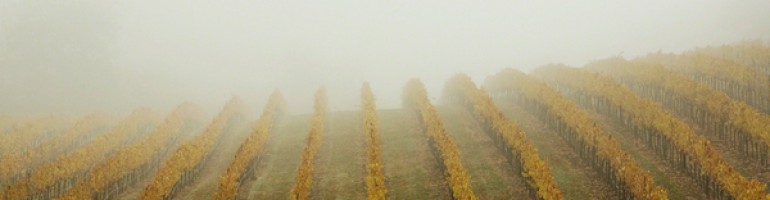
Remember those Cool Climate varietals… if there is enough sunshine to fully ripen the berries at these sites, WATCH OUT! These wines are amazingly good. These vineyards can produce complex, fruit forward wines with high acidity. Watch your vintages with these producers. In cooler years, these wines can be very rustic, and/or thin. U.S. Examples: Santa Rita / Santa Maria AVA, or Russian River AVA.

Finger-Lakes-vineyard

(Finger Lakes Vineyard)

Inland Locations Adjacent to Large Lakes

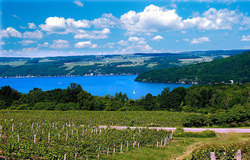
Often, cold winter climates can support vineyards in these areas. The lakes moderate the low temps at night during bud-break and harvest (Spring & Fall). Depending on the amount of sun, these vineyards can produce fresh, brisk white wines, or a well-balanced lighter style of red wine. U.S. Examples: Lake County AVA or Finger Lakes AVA.

Sonma coast Vineyard

(Sonoma Coast Vineyard)

Coastal Locations

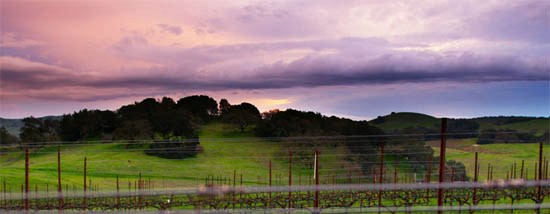
These sites can produce excellent, or horrible fruit from vineyard to vineyard. The best sites don’t get a lot of rain and are watered by the dew and fog. In addition, higher elevation sites adjacent to the coastline are an advantage. The elevation offers more time above the morning foggy conditions to ripen the fruit and destroy the potential mildew. These vineyards will not produce easy drinking wines, but if you like complex flavors (sometimes unusual) and good structure, try a few of these and find out if they are for you. U.S. Examples – Sonoma Coast AVA.

Conclusion

Valley floor locations almost always produce easier drinking softer wines, especially when located in warmer climates. These are not my kind of wines, but I recognize that many consumers enjoy this style. Each to their own, but at least with this information, you can understand what influences how these wines taste. If you are willing to evaluate your preferences and find the vineyard locations that match your palate for each varietal, it will enrich your wine experience (find my preferences below).

Vineyard Locations I Prefer (a few)

Chardonnay – Burgundy AOC, Champagne AOC, Mendocino AVA, Santa Maria and Santa Rita Hills AVA, Russian River AVA

Sauvignon Blanc – Marlborough Appellation, Sancerre AOC

Chenin Blanc – Vouvray AOC, Stellenbosch and Swartland Appellations

Merlot – Right Bank Bordeaux AOC, Spring Mountain AVA, Walla Walla AVA

Cabernet Sauvignon – Napa Valley AVA, Left Bank Bordeaux AOC, Bolgheri Superiore IGT, Maipo Valley Appellation

Syrah – Southern and Northern Cotes du Rhone AOC, Paso Robles AVA, Walla Walla AVA, Barossa Valley Appellation

Pinot Noir – Burgundy AOC, Willamette Valley AVA, Santa Rita Hills AVA

3 Comments

Filed under Cool Climate Wine, Wine Education, Wine Industry, Wine Travel