Category Archives: Wine Travel

Holiday/vacation travel adventures with food, wine and vineyards involved.

Why Do Wines Taste Different? – Part 2a: Climate

Continuing the two part series, well… I realized this topic was just too much for one additional piece. Don’t forget, I am no industry expert. This piece is only offered from the perspective of the impact on enjoyment of wine flavors and structure. Folks, I have tasted a LOT of wine. Over the years, you ask questions, and you learn which factors affect the wine and how. Now I am sharing that experience with you.

PART 2a – How Terroir Affects the Fruit 

This second part in the series is the most complicated. This installment in the series provides insight into the location factors that influence wine flavors. It is impossible to cover these next topics without technical detail. I apologize in advance for diving into the dryer Somm training. I will try to associate these influencing factors with their specific impact on flavors and structure, so it will offer more interest and meaning…
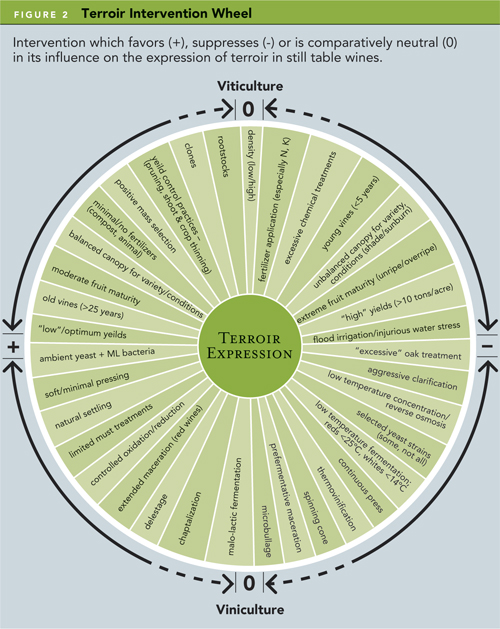
0601_g1_2_terroir-wheel

Climate is closely related to the idea of “terroir”. I put the term in quotes, because it is a concept more than a word. Terroir impacts both flavors and structure in wine (for example: blackberry and acidity). Here is the Webster Dictionary definition: “The combination of factors including soil, climate, and sunlight that gives wine grapes their distinctive character”. Close, but there is more to it than just that. Some additional ideas would be: proximity to bodies of water (i.e. lake, ocean), heavy winds, or fog during the growing season and the most important – local wine growing traditional practices.

Each of these can have a bigger influence than you would think:

  • Foggy mornings can add a considerable amount of acidity to the fruit and ultimately the wine.
  • Heavy winds have a more basic function – the wind keeps the berries dry, so thinner skinned varieties (Pinot Noir, Merlot) can be grown in humid climates, without mildew and rot.

Wine growing tradition can affect things like:

  • Trellis design – Overhead trellising (called Pergola and common in Italy) makes it impossible to practice canopy management. This can lead to inconsistent vintages from varying weather conditions. Without canopy management, it is difficult to control producing burnt vs. under-ripe fruit from year to year. Italy has been slowly converting their premium vineyards to head-trained trellis and pruning systems for this reason.
  • Yield per acre – Some regions can produce 8 tons of fruit per acre, or more. This is bulk wine territory. You can taste the difference when fruit is pruned from the vines early and the yield is reduced to 2-3 tons per acre, commonly found in the premium wine category. This always develops more concentrated and complex flavors. Ask a winery about the yield per acre for their fruit source. They should be able to tell you immediately. It is a VERY important decision and will separate quality wines from bulk wine. Your dividing line is at about 4 tons per acre.

Terroir can also be a philosophy of sorts. Have you ever considered wine to be a unique indicator of “place”? Wine can and does reflect local cuisine and culture. In many of the Old World wine growing regions, wine is viewed as a definitive indicator for the location where it is made. That is why they have actual government laws regarding how wine must be made in many regions. In this way, Wines from St. Estephe AOC, or Sancerre AOC all have a consistent character. Before my Somm training, I would have told you this was completely crazy. In the U.S., we don’t think of wine in this way, but still… when I drink a Napa Cab Sauv, it does take me back to past visits to Napa Valley.

Affects of Climate and Location on Wine

So, now let’s pick-up where we left off in Part One and dive into the climate and location factors that influence the flavors in wine:

Where is the vineyard located, in a: Maritime (adjoining ocean), Continental (inland), or Mediterranean (moderate temps & ocean influence) Climate? If you add soil type, these are THE most important factors in vineyard influence on the wine. So, how does this affect the way we experience the wine? Let’s start with climate. The primary impact of climate is on the varietal selection planted. As an example, varietals grown in the Loire are completely different than those grown in Bordeaux and those choices have an obvious impact on flavors in wine from the two regions. Within the same varietal wine, the climate difference impacts structure: Acidity, Tannins, Alcohol, Complexity (especially mid-palate) and Balance. This is the part of the discussion that becomes more variable and interesting.
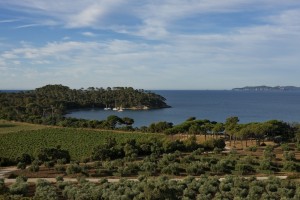
Winery Provence

Provence Region, France

Maritime Location

In Northern Latitudes, these locations can be cool with fog, but winter temps stay moderate. If the growers can get the grapes fully ripe, watch out – fantastic wine results. Think acidity here. Wonderful climate for growing cool climate red varietals (if the soil is right) like Pinot Noir, Cab Franc and Syrah. This type of climate can also produce interesting cool climate style whites, like Chardonnay, Albarino and Pinot Gris. Think U.S. Sonoma Coast, or Spanish Rias Baixas. In Southern Lattitudes, the hot days and cool nights make killer warm climate reds, like Cab Sauv, or Grenache. Think French Provence, or Italian Tuscan Coast.
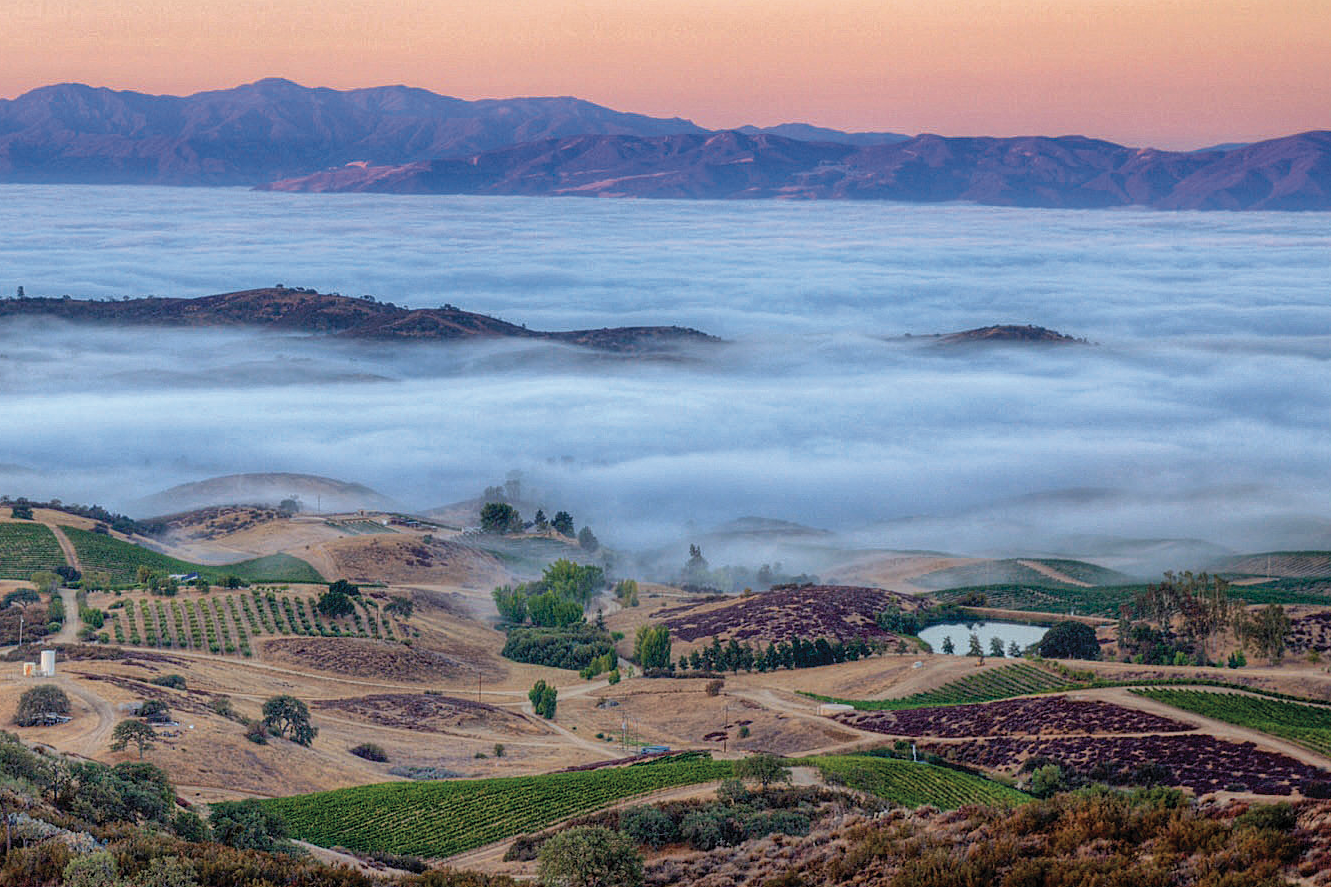
Clear Lake Pic

Clear Lake Region, CA

Continental Location

These inland locations do not have the moderating affect of the ocean, so these regions cannot extend too far north, or south for that matter. Wine grapes have very specific climatic needs. A very interesting and different example is the California Clear Lake AVA – an inland location, but at higher elevation with a large adjacent lake. This AVA is starting to produce structured wines and as the local industry comes to understand the vineyard sites better, the wines form this area will continue to improve. The varying Continental climates can produce a wide array of varietals. Burgundy, France is the classic premium appellation. In the U.S., it might be Walla Walla Valley AVA.

northern-rhone-vineyard

Rhone Region, France

Mediterranean Location

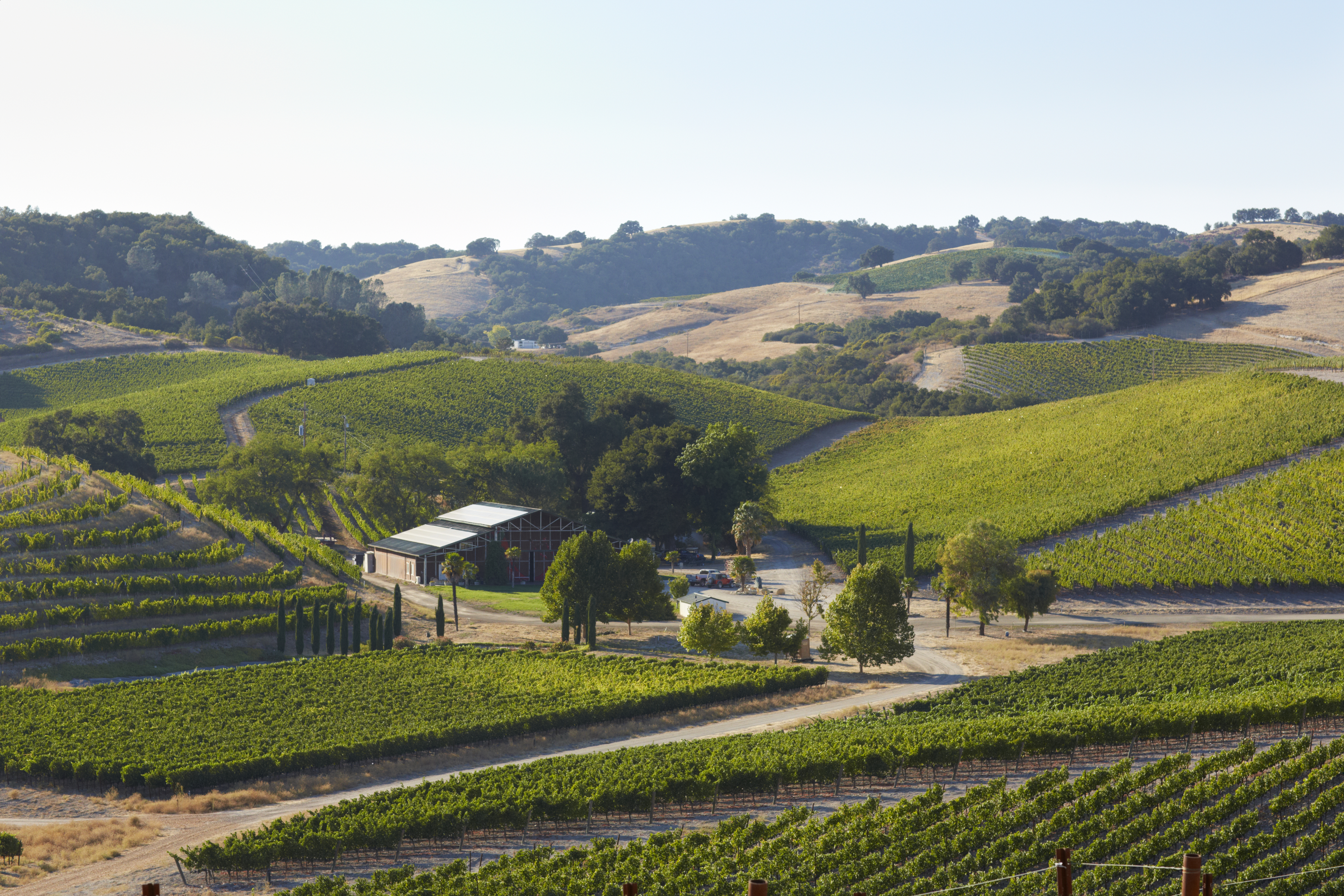
These wine growing locations tend to be in southern latitudes, inland along rivers within 50-150 miles (or so) of the coast. The best reds produced in these areas are usually from Syrah and Mourvedre grape varietals. In the whites category, the varietals to look for would be Viognier, Marsanne and Roussanne. These areas offer some of the most complex wines in the world. You often find wines from these areas with crazy flavors, like: olive tapenade, tar and mint. Sounds unpleasant… but try extending your budget when the opportunity arises and buy a nicely aged bottle of Cote Rotie. Be prepared to have your socks knocked off! The classic premium appellation might be the Rhone Region in France. In the U.S., it would be San Luis Obispo County (Paso Robles AVA).

Conclusion

If you haven’t noticed what these locations have in common, think hot days and cool nights.

Grape vines need enough sunshine to ripen the fruit, but not too much heat… or else the wine tastes too flabby (try bottled grape juice). Cool nights add acidity, without which wines taste flat. It helps if Winter can be a little cold, so the vines can more effectively shut-down, go dormant and rest part of the year. Extremes within any of these factors makes for lousy wine, or dying vines.

This has been a brief review of Climate and its impact on Wine. The next piece will cover our most favorite topic – DIRT and vineyard site selection. I hope this series is offering deeper insight into the factors that affect wine flavors and structure. In particular, if you are interested in Wine Travel, this is the information that will make the experience much richer!
2 Comments

Filed under Cool Climate Wine, Wine Education, Wine Industry, Wine Travel

Best Value Wine Destination in the U.S.A.?

value pic

I was recently involved in a discussion regarding preferred wine tourism destinations among serious wine drinkers / collectors. Napa Valley is consistently drubbed for its utter lack of value. Average tasting room fees are $25 – $40/pp… to access top quality, it is not uncommon to pay $75/pp. Now granted, these wineries are so gorgeous – Napa Valley itself creates its own ambiance, but let’s move past honeymoons and anniversaries and talk year-in and year-out wine tourism destinations. My wife and I have vacationed in Napa at least 10 times in the last 20 years and while it was previously my favorite location, it is now third on my list behind the California Central Coast and Sonoma County. To make things worse, Napa tasting rooms have steadily become more impersonal, making me feel like one of the massive herd, or a bother, rather than a valued guest.

Yes, my favorite wine destination is the Santa Barbara and San Luis Obispo Counties area in California!

Destination Comparison

Cuisine / Restaurant SceneWinner Napa Valley

The Central Coast is improving, but still has catching up to do.

Tasting Rm FeesWinner Central Coast

1/3 to 1/2 the cost of Napa.

Tasting Rm AtmosphereWinner Central Coast

The Central Coast is a big winner here. I have been getting tired of the attitude in Napa. The tasting rooms are so much friendlier almost anywhere else. I miss 10+ years ago when wine tasting was casual and inviting!

Lodging ValueWinner Central Coast

1/2 the cost of Napa with several resort quality properties to choose from.

Quality of WineWinner Central Coast

Slight edge, not because any single wine is superior, but because overall – the wines approach Napa in quality and the selection is amazingly diverse. There are top quality producers of Syrah, Cabernet Sauv, Zinfandel, Pinot Noir and Chardonnay here… in Southern Rhone, Bordeaux and Burgundy styles. All of this diversity is driven by an area with crazy climate variability.

SceneryWinner Napa Valley

Maybe not as cozy as Napa Valley, but the hill and mountain regions west of Hwy 101 are very picturesque.

BeachWinner Central Coast

No Beaches near Napa. This region has Pismo Beach.

Winery ArchitectureWinner Napa Valley

Napa has a big edge here, but some wineries are starting to spend big money in the Central Coast area.

l'aventure winery

l’aventure winery

A Paso Robles Vineyard & Winery

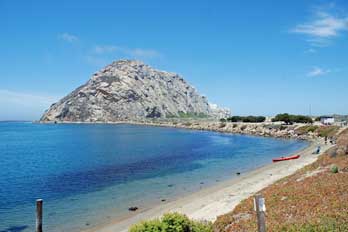
Morro bay pic

Morro Bay, CA

Central Coast Winery Suggestions

(arranged from South to North)

Santa Barbara County

Carr Vineyards – All wines are good, but their 100% Cab Franc is special and reasonably priced.

Jaffurs Wine Cellars Quality Southern Rhone style wines that offer great value.

Brewer- Clifton Pinot Noir and Chardonnay. Their Chardonnay is Burgundy style and fantastic!

Qupe – Beautiful, refined Syrah by a master winemaker.

Andrew Murray Vineyards The best value quality Syrah in the U.S. hands down.

Melville Winery Great values in Burgundy style Pinot Noir.

San Luis Obispo County

Laetitia Vineyard & Winery – Fine quality sparkling wines in a broad selection of styles.

L’Aventure Winery – Balanced Hedonism Incarnate (is that possible?). These wines are massive, powerful… and perfection.

Peachy Canyon Winery No winery makes more different single vineyard Zinfandels. If you are a Zin Master, you must visit Peachy.

Tobin James Cellars Their tasting room is definitely the most fun in the area!

Justin Cellars This is your bastion for Bordeaux style wine in the area. Their Cab Sauv and Merlot blends are very good! These wines are approaching the quality of the best in Napa.

Herman Story Wines THE BEST Southern Rhone Style Wines in the United States at prices that will cause you to do a double-take.

Other Wineries of Note Some of best wineries in the world are making amazing wine here, but are expensive and difficult to arrange access:  Alban Vineyards, Saxum Vineyards and Sea Smoke Estate Vineyards.

New Destinations My wife and I will be traveling to Walla Walla, WA this fall, six years after our last trip. I am hoping this location has much to show! I am looking for my next wine destination to add to our list! I will update our findings on this site after our trip!

2 Comments

Filed under Wine Industry, Wine Tasting, Wine Travel

Terroir Controversy

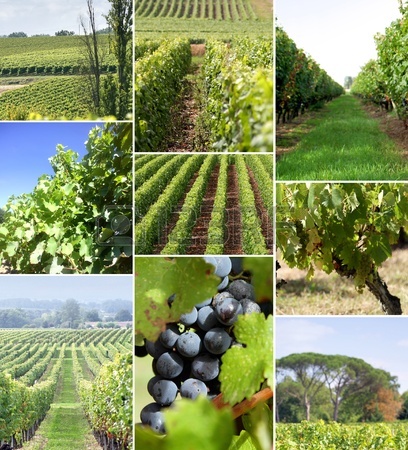
images-of-a-vineyard

Terroir – Webster Dictionary Definition:

“The combination of factors including soil, climate, and sunlight that gives wine grapes their distinctive character.”

What a simplistic explanation!  Does “soil” include proper drainage, or the angle of the grade?  Does “climate” include the daily temperature variation?  Does “sunlight” include the degree of latitude?  All of this and much more make up the definition of Terroir.  I can think of other related factors: the altitude of the vineyard, are the vineyards terraced, is the vineyard in full sunlight, or shaded at times, etc…

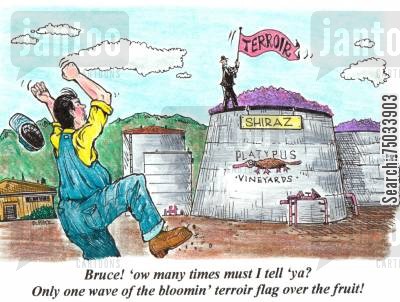
'Bruce! 'ow many times must I tell 'ya? Only one wave of the bloomin' terroir flag over the fruit!'

Is Terroir a Real Concept?

“Terroir” has been one of the most misunderstood and controversial concepts in the wine industry, since vineyards began popping up all over the New World.  It has been a critical part of the tradition of European winemaking from it’s very beginnings.  European wines have always been more about “Place”, than Varietal.  New World skeptics continually site the lack of scientific data that supports the chemical impact of soil composition on flavors developed in wine grapes… completely absurd! Whether, or not the chemistry supports it, your palate can taste it.  Most contrary opinions point to the soil component, when Terroir is actually so much more.  Soil is just a small piece of the vineyard conditions that impact the character of wine.

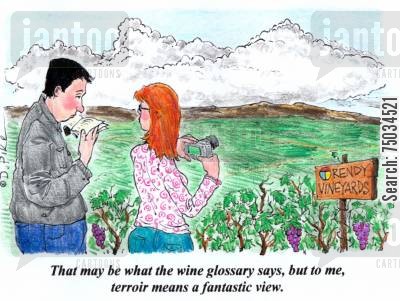
'That may be what the wine glossary says, but to me, terroir means a fantatic view.'

A Personal Connection to Terroir

I usually recall most wines by either vineyard, or winery location, or the underlying experience, rather than the flavor.  I prefer wines aged in neutral oak, rather than new oak, so the fruit can express itself fully.  When I taste acidity, I see morning fog in the vineyards.  When I taste savory flavors, I think cooler climate.  When I taste concentration, I think small berries and making the vines work hard to ripen…  There is more to the impact of Terroir, than just added minerality.  Sometimes, when I sit alone enjoying a well made wine, I try to visualize the vineyard from the character of the wine.  Focusing on “Place” can truly enhance your enjoyment of wine, if you embrace the idea.

Why Does Terroir Matter?

UC – Davis has added so much to the world of wine in the last decade and it is exactly that influence that has swung the pendulum too far.  A scientific approach to wine can foster a dependence on chemistry alone in making decisions impacting the final product.  I have been looking at this issue for many years now and have come to the conclusion:  the making of wine is definitely equal parts science and art.  Two prominent winemakers I interviewed this year (Kathleen Inman and Todd Anderson) embrace this kind of thinking.  Their ideas are interesting and worth sharing, because they focus winemaking on the result (not the process).  This winemaking strategy requires starting with a vision, even before bud-break.  In my experience, this alternative view is more likely to produce balanced and structured wines with a textural component. That last piece is too often missing from wines today.

So, where does this topic fit into the idea of Terroir?  Very simple… a poor understanding of the fruit and its influences will cause poor winemaking decisions.  Winemakers cannot express the art in their craft, without an understanding of the Terroir that has produced the fruit.  I will take this even one step further… Terroir is not a fixed concept.  Vintage variation from year-over-year of climate change can influence the sense of “Place” that wine brings.  If these ideas are starting to connect, you will realize vintage variation is NOT such a bad thing.  It just ties you closer to “Place”.  When a winemaker works with climate variation (instead of fighting it), some years the wines are silky instead of velvetty, lighter instead of heavier bodied, or have soft instead of chewy tannins.  Personally, I enjoy most wine styles and can really appreciate that diversity, often coming from the same vineyard each year.

'As Chuck's definition of terroir dragged past the 20-minute mark, Suzy concluded, the longer the explanation, the less likely you know what the word means.'

Are We All Tired of This Discussion?

Everyone associated with wine in any way has probably had this discussion at one time, or another… and is probably tired of the topic.  Please don’t lose your patience, it is much more important than you may realize.  It could even hold the key to introducing an appreciation of premium wines to the average consumer.  If my introduction to wine was any indication, I was appreciating Terroir long before I even knew the word.  I enjoyed wine country vacations for many years, before I understood what I was drinking.

Humor me for a second… visualize:

  • sitting in a rocking chair at sunset
  • on a porch overlooking row upon row of vineyard
  • enjoying a glass of wine

It just sort of warms the soul!  I think there are more consumers that would connect with this experience than the industry realizes.

Now stop and ask yourself:  

  • Did you choose a location for that view?
  • Did a specific wine, or style come to mind?

Wine can enrich life, but you must choose the path and open your mind… a few other people through history agree with me:


“If you have to ask if it’s too early to drink wine, you’re an amateur and we can’t be friends.” – Anonymous

  • I will have to use this one next time I visit Napa…

“Good company, good wine, good welcome, can make good people.” – Shakespeare

“Wine is more than a beverage, it’s a lifestyle.” – Anonymous

“Wine to me is passion. It’s family and friends. It’s warmth of heart and generosity of spirit. Wine is art. It’s culture. It is the essence of civilization and the art of living.” – Robert Mondavi

  • This is a great quote. He was able to put into words the affect wine had on his life.

“Great wine requires a madman to grow the vine, a wise man to watch over it, a lucid poet to make it, and a lover to drink it.” – Salvador Dali

“Wine is sure proof that God loves us and wants us to be happy.” – Benjamin Franklin

1 Comment

Filed under Wine Education, Wine Industry, Wine Tasting, Wine Travel

A Wine-O Walks into a Bar, and…

Wine Bar in Italy

One day last year, my wife and I walked into a wine bar in Castello di Bolgheri, Italy (OMG, this sounds like the beginning of a joke!). They had 20 wines in a commercial dispensing system… Sassicaia, Ornellaia, Le Macchiole, Sapaio, Grattamacco, Ca’ Marcanda and more (pardon mixing my wines/producers) and I blew a boatload of cash sampling higher priced, older vintage, hard to get wines in 2 oz. pours. Never saw such an impressive selection of wines BTG in my life! I will remember the fun we had that night for many years!

Wine Bars and the U.S.

Could this wine bar concept be successful in the U.S.? Let me throw this out there… could providing wine education and then exposure to these kind of exquisite wines from all over the world be successful? Obviously, the demographics of the area would be a huge factor, but assuming you were located in a high-income area… could it make business sense, or would it be a disaster? Definitely – paired tapas and the right atmosphere would be a must.

A Passion for Wine and Curiosity

In my case, I am always curious about ultra-premium wines. Frankly, it is fun trying to determine if the value makes sense, or the price point is bogus. In the process, you always run across an amazing gem, like we did that night. Although generally, I am not up for spending big money on a full night of it. In this case, my wife and I were on vacation and we decided it would be fun to treat ourselves to the experience. Are we the only couple with disposable income that feels that way? Would the location have to be a tourist wine destination like downtown Napa, CA? Will the new Coravin wine preservation system provide the method for making this concept work?

Which Wine Experience Are You Looking For?

Being of entrepeneurial spirit, I try to guess at the different kinds of consumers that make up the marketplace. When you choose to drink wine at a bar, or restaurant, what most influences your selection?

1) pair with food 2) price 3) value 4) broad appeal for the entire party 5) explore new wines 6) the old dependable 7) hunt for exceptional quality 8) try multiple wines and a diverse experience

Is seeking out an exceptional wine value on your radar, or like many believe… are you just looking for a passable wine at the right price? Many in the industry have the view that people are just happy to be out enjoying a good time with friends…

$700 USD/btl for Harlan Estate Cab? Really?

Here are a few lines from a recent wine auction. Sorry, vintage dates are missing, but you get the point. $75+ for a 2 oz. taste of wine? I don’t think many would be curious enough, although I have watched people pay that for a shot of utra-premium tequila…

Harlan Estate, Napa Valley, USA – $709
Schrader Cellars Old Sparky Beckstoffer To Kalon Vineyard Cabernet Sauvignon, Napa Valley, USA – $624
Caymus Vineyards Grace Family Vineyard Cabernet Sauvignon, Napa Valley, USA – $617

How about $25+ for a taste of these wines?

Paul Hobbs Beckstoffer Las Piedras Vineyard Cabernet Sauvignon, St Helena, USA – $182
Dominus Estate Christian Moueix, Napa Valley, USA – $180
Bevan Cellars ‘Oscar’ Sugarloaf Mountain Proprietary Red, Napa Valley, USA – $180

Or these?

Chateau Montrose, Saint-Estephe, France – $192
Chateau Haut-Brion Le Clarence de Haut-Brion, Pessac-Leognan, France – $192
Chateau Lynch-Bages, Pauillac, France – $188

At some point, you become saturated with high-priced offerings beyond your budget. Occasionally, I stop and think about all the buyers out there spending this kind of money on wine. Sometimes… I just can’t get my head around the wealth that must be out there.

Wine Bars in My Area

Don’t know about you, but I look for decent food and ambiance with great value wines in the low, mid and higher priced categories. Sometimes, you are out on a special occasion and want to splurge. Having craft beer on tap too is a plus, for the times when a beer just sounds right. Unfortunately, this ideal place does not exist within 20 miles of my home and has me wishing… and hoping, the next new entrepeneur will take the risk and get it right.

1 Comment

Filed under Food Pairing, Restaurant, Sommelier, Wine Education, Wine Industry, Wine Tasting, Wine Tasting Notes, Wine Travel

Can Wine Education be Fun and Interesting?

I hold consumer wine education programs, typically at wine bars and restaurants. The classes are intended to draw additional traffic to the venues to build a clientele and drive paired food revenue… but ultimately, consumers are drawn by the desire for wine knowledge.

What Consumers Want to Know

Through a few years of experience I have found what works and what doesn’t.  You can put people to sleep with the information that interested me in my formal training… history of wine production and regions, impact of terroir on flavors, impact of wine making techniques on the wine, etc.  What do people enjoy learning about?

Wine – Food Flavor Pairings

Learning how different food flavors impact the perception of the white, red, sweet wines, etc.  Setting up paired tastings to reinforce the concept.  Most are very surprised how food impacts wine.  It is rare to find casual wine drinkers that have explored this.

What are Those Flavors I am Tasting in Cabernet, or Merlot?

People want help learning standard varietal profiles.  Take them through the blind tasting process and how to create wine tasting notes.  They want to know how to talk about wine with others.  Blind taste a few for the wow factor.

How Do I Describe What I Enjoy to Wine Attendants?

Teach them how to describe their wine preferences to assist in wine selection at restaurants and wine bars.

How Do I Select Wines to Purchase Based on My Preferences?

Walk through a wine selection process based on that description, without tasting the wine.

Would I Enjoy Exploring the Diversity in Wine?

Introduce people to the diversity of flavors in wine and provide specific examples.

Would I Enjoy Wine Travel?

Discuss wine travel and destinations – relate stories of individual wineries, their beauty and ambiance.

ULTIMATELY, MOST PEOPLE WANT WINE TO BE FUN!

When I first began presenting these programs, I was disappointed people were not interested in the academic side.  Took a few to understand, they don’t want to talk about bottle aging, cellaring strategies, AOC & DOC labeling laws…  People just want to learn how to facilitate buying wine they enjoy and how to enhance their shared wine experience with friends.

Comments Off on Can Wine Education be Fun and Interesting?

Filed under Restaurant, Sommelier, Wine Education, Wine Tasting, Wine Travel

California Clear Lake AVA – Up and Coming Cool-Climate Region

Tasting the Wines

I have recently tasted a few wines from this region: Ceago Merlot and Chacewater Malbec. While not yet having reached the status of other cool-climate growing regions such as Mendocino Ridge,  or Santa Barbara AVA’s, I was quite impressed with the improvement in the wines since my last taste through this area. Better structure and balance than in the past and the wines seem to be finding the cool-climate complexity that I have come to really appreciate.

The Future of Clear Lake AVA Wines

For a continental climate, the area has an extreme moderating factor – the largest freshwater lake in California in its midst. The climate is much cooler than the nearby North Napa Valley area, due to its elevation. The growing season seems to drop just cool enough to add character and acidity, but stays warm enough during the day to allow ripening of red varieties such as: cab sauv, merlot, syrah, petit sirah and malbec. It is time for me to visit the wine trail in this area again and talk with the winemakers. At prices in the $15-$30 range, the QPR (quality to price ratio) of these wines is good… but my hope is, the quality will continue to improve and I will have another area seriously contending for my wine dollars.

Comments Off on California Clear Lake AVA – Up and Coming Cool-Climate Region

Filed under Cool Climate Wine, Wine Industry, Wine Tasting, Wine Travel

Wine: The New Breakfast Drink?

World Wine Culture

Consumption patterns across the world are so different it can be startling. Here in the U.S., the largest share of the wine market is Chardonnay as an aperitif. Last year I was in Alba, Italy and was lucky enough to witness a few local winemakers having a discussion about the proper wine to pair with breakfast! They settled on a Dolcetto table wine at 10% ABV

Wine, its place with cuisine and its socially acceptable consumption is perceived very differently from country to country. I was in Germany earlier that year at a wine festival in Stuttgart and there must have been 100 producers there, with a 1000+ Germans very happily drinking sweet Riesling and Spatburgunder with their schnitzel & spatzele (very little dry wine). What an awful wine-food pairing, based on the U.S. palate. To a large extent, wine demand represents local preference, i.e. the weak market for import wines in California.

Breakfast of Champions, or NOT

So, could a wine producer develop a market in the U.S. for a very light, low alcohol red wine with a minimum of fruit, like the breakfast Dolcetto in Italy? Doubtful… but it sure has me thinking about the lifestyle associated with that kind of demand. I may be living in a shack on the beach in Italy soon! Wait, it would never work. My wine cellar would never fit!

Comments Off on Wine: The New Breakfast Drink?

Filed under German Wine, Italian Wine, Wine Education, Wine Industry, Wine Tasting, Wine Travel

Sassicaia vs. Ornellaia Smackdown – The Battle of the Super Tuscans

In a recent trip to Italy, my wife and I stopped into Enoteca Tognoni and tasted all wines on tap.

In general for the price point, the wines tasted were disappointing, with a notable exception. All the wines were very much French Bordeaux in style, but missing the finesse of the fine wine making tradition in France. One of the exceptions was Tenuta San Guido. Sassicaia was a truly an amazing wine and far beyond the other wine there. We also tasted Le Macchiole, Ca’Marcanda, Sapaio, Guado al Tasso and Grattamacco, but the Sassicaia and Ornellaia were clearly above the others. Tasting notes below:

2009 Tenuta San Guido Sassicaia 95 Points

Italy, Tuscany, Bolgheri

Tasted with a plate of prosciutto, cheese, olive oil and bread. Started just like a typical Super Tuscan… light texture, subdued alcohol, red and black cherry fruit with a dark chocolate finish… then, as you ponder what’s in the glass, the realization hits you. This wine is so well made, nothing is out of place and the entire experience is just right. All parts of the wine show themselves without overpowering. The texture is light, but silky and coats the mouth. There were strong tannins and acidity for a good backbone, but it did not prevent the wine from coming together. This wine presented a beautifully balanced, structured and harmonious profile.

2009 Tenuta dell’Ornellaia Superiore Ornellaia 92 Points

Italy, Tuscany, Bolgheri

Tasted with a plate of prosciutto, cheese, olive oil and bread. Again, a typical Super Tuscan… light texture, subdued alcohol, red and black cherry fruit with a dark chocolate finish. Definitely well made, but did not leave you with that “wow” factor. For the same rough price point (approx. $200/btl.), the Sassicaia had bowled me over, whereas the Ornellaia just had me thinking this is “pretty darn good”. Maybe a little too thin in comparison? There was good structure, with strong tannins and acidity here too.

Conclusion

Perhaps the comparison was unfair and it was simply that particular vintage, but the difference seemed to be in the vinification, rather than the quality of the fruit. Of course, it could just be a personal preference, but for me the Sassicaia was not only more accessible young, but showed tremendous bottle aging potential.

Comments Off on Sassicaia vs. Ornellaia Smackdown – The Battle of the Super Tuscans

Filed under Bolgheri, Cool Climate Wine, Italian Wine, Super Tuscan Blend, Toscana, Wine Collecting, Wine Tasting, Wine Tasting Notes, Wine Travel

Wine & the Football Couch Potato

My wife and I started our wine country vacations nearly twenty years ago. Not very long after, we began collecting wines. At first, we stored the wine in racks, then later in expensive environmentally controlled cellars. Initially, we bottle-aged reds only, then whites and finally sparkling. A couple of years ago, I was formally trained in a classroom, passed the Sommelier exam and received my certification. It has been a wild and crazy ride. If this already has you thinking, “I could do that!”… It is time to accept your secret inner wine-o and warn your children. The first one to move out will lose his/her bedroom to a well-decorated, Tuscan themed wine room!

The Transformation

I graduated from a beer and whiskey drinking male stereotype, to someone who spends a good chunk of his income on fine food and wine. How the heck does THAT happen? I think my path broke the mold when it comes to your typical wine-o/foodie archetype. For the 6-pack of Budweiser Sunday football guys everywhere (old me), I will attempt to look deep inside and reveal the wonder of this miraculous change.

1. Romance

No, not that namby-pamby touchy-feely kind. When a guy figures out that your honey can be talked into just about anything, after a few bottles of REALLY GOOD red wine on a patio overlooking a beautiful vineyard, you will understand the connection between wine and hormones.

2. “Mellow Buzz”

The red wine effect is unlike any other alcoholic beverage. You feel good, warm inside, relaxed, sexy, friendly and all the world’s problems are thoroughly pointless.

3. Social Connections

You meet people when enjoying the wine country and drinking wine. It adds friends to your circle and you get the extra added benefit of impressing them with your manly description of floral aromas.

4. Cheap Wine vs. the Good Stuff

If only I had never traveled to Napa that first time, it would have saved me at least $100K over the last 10 years. Before that trip, I had never spent more than $15 on a bottle of red wine and it was all pretty awful. Had I been born in Italy, where the difference between cheap wine and the good stuff is not as great (topic for another day), my life would have been entirely different. I would have been wealthier, closer to retirement, much more good looking and writing this post from my villa on the Tuscany coast.

5. Crazy Flavors in Wine

How the heck do you make grape juice taste like graphite, or tobacco? Or for that matter… mint, bacon, or eucalyptus? The big guy upstairs really put some mojo in those grapes!

6. Adventure

Terroir is more than a Dictionary definition, it is a wonderfully engaging concept. Not just from the perspective of its impact on flavors, but the idea of “place” it brings with it. With every new wine region, it brings new expressions of different varietals, new flavors and aromas… and provides a very different experience. Tie that to the regional cuisines associated with each and you have an endless journey of discovery.

The Journey

There it is. I never pushed. I was always drawn along the path. Ladies, want to see if that Sunday football couch potato can transform into the kind of guy that talks YOU into a vacation in the wine country… here’s your template. Best of luck though, while he may become that dreamboat you always wanted, he is sure to be in the poorhouse begging for foie gras on the nearest street corner!

Comments Off on Wine & the Football Couch Potato

Filed under Wine Collecting, Wine Education, Wine Tasting, Wine Travel

Managing a Personal Wine Collection

Years back I realized… once the number of bottles you lay down exceeds your ability to remember them, one of two things will happen:

  1. Curse your aging brain and struggle on

  2. Give in and realize there must be a better way

WHY Manage Stored Wine?

Initially, I was too proud to give-in and track my wine. After the issue bubbled to the surface (added sparkling to my cellar 🙂 ) it became clear, not having the ability to generate a list, or establish drinking windows, significantly affected our enjoyment of the wine. It doesn’t matter whether you drink wine daily, or just on the weekend. You will begin to realize (as I did), managing your wine inventory is a key component to maximizing your investment and enhancing your wine experience. So, the next step is to go totally overboard (like the crazy person I am) and put the program together.

Pick Your App/Software

I settled on CellarTracker. That has turned out to be a good decision. I highly recommend this cloud-based app, not just for cellar management, but for the tasting notes and the community too.

Separate the Inventory to be Bottle-Aged

So you disturb this wine as little as possible.

Identify the lower-priced daily-drinkers and rack separately

You will go through this wine quickly enough. It will not require a controlled environment.

Calculate your annual consumption of bottle-aged wines

Let’s round your hypothetical collection to 100 bottles (insert your own quantity). One possibility – assume you drink a nice bottle every other weekend, or round to 25 btls/yr. Purchase your wines to be bottle aged separately from those for drinking now. In this scenario, simply buy 25 bottles for aging every year… this assumes that every wine has the same aging capacity. The annual number of bottles is important. Knowing your number will save you money down the road, when competitively shopping your purchases. Don’t forget to add wine to your calculation and include a party, or two and a few dinners with friends and wine…

Wine Purchases Should be Planned

Plan Purchases so groupings of your aged wine will be constantly maturing and ready to drink

I can’t think of a better reason to diversify your cellar with Red Blends, Pinot Noir, Syrah, Cabernet Sauvignon, Malbec, etc. These varietals (depending on winemaker’s style) typically bottle age at different rates. If you can’t wait the 3-4 years it takes to develop your own collection of 5+ year old aged wines, supplement your buying with older vintages from auction sites (like WinBid.com, WineCommune.com, Hart-Davis Hart), or you can ensure provenance by buying from well-known brokers (like Benchmark).

OK, I am outed. I am a real wine geek.

Just to let you know, these are some of the same basic strategies needed for managing a commercial wine cellar. Coming down the pike… more posts on: Why cellar wine? and Wine Buying Strategies (in states where laws allow).

Comments Off on Managing a Personal Wine Collection

Filed under Wine Cellar, Wine Collecting, Wine Tasting, Wine Travel