
Tag Archives: Wine Marketing

What Can Wine Consumers Expect in 2026?

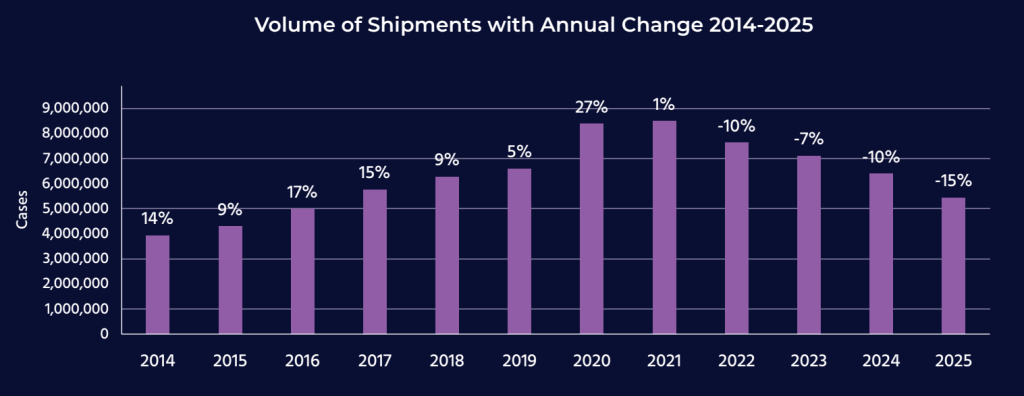
From SOVOS ShipCompliant & Wine Business Analytics 2025 report.

The latest numbers from the wine industry are hard to believe. In talking with a few people I know, these reactions/ideas were kicked-around:

Direct To Consumer Wine Sales Numbers for 2025

The speed at which demand destruction is changing the wine, beer and spirits industry is hard to comprehend. Keep in mind, CA sells about 75% of all U.S. wine. DTC (direct-to-consumer) wine sales from CA, excluding the Napa AVA, have dropped almost 50% since 2021. 2025 CA DTC sales without the Napa AVA dropped 32%. Napa sales were roughly flat. See direct excerpts from the Sovos DTC Wine Report for 2025 below.

  • “This year’s DTC data shows that no obvious bottom emerged in 2025, as the year over-year changes in both volume and value of DTC shipments saw record decreases of 15% and 6%, respectively. Moreover, after three years of smaller increases in average bottle prices, 2025 saw a significant 11% increase in average price per bottle shipped, to a record $56.78. 2025 was the most disappointing year for DTC wine shipments since this report was first published in 2010. All told, in 2025 the DTC shipping channel retreated by more than 967,000 cases and gave up over $230 million.”
  • “Only one region, Napa, eked out a gain in value of shipments at 1%. The Rest of California region experienced a drop in volume of 32%, resulting in a 47% decline in the volume of shipments from Rest of California since 2021.”

Media reports are estimating, roughly 50% of the wine grapes grown in CA last year were not harvested. If confirmed, there will be a U.S. bulk wine fruit/juice shortage in 2026, unless consumption continues to drop. The latest harvest numbers are showing the industry is planning for a continuing major drop in consumption.

Effect on the Typical Wine Enthusiast

What impact does this suggest for the premium wine consumer? The current world trend seems to be “drink less, but better”. In my opinion:

  • Total wine consumption in the U.S. was down 2% again in 2025 (more in other countries), but as you see above, DTC was hit much harder. **This will put pressure on smaller wineries without commercial distribution to find ways to get closer to customers. Keep an eye out for good things from your favorite smaller wineries.**
  • For those of us that are buying for their cellar… **keep an eye out for flash sales / dropping auction prices for quality labels at distressed prices, in the short term.**
  • The price impact on higher quality wines in each price category will be less. Demand for trained, experienced premium winemakers will be high. **Follow your favorite winemakers as they move.**
  • In the longer run, it will take time for the major premium/luxury labels of the world to right-size production and inventory. **When that finally happens, I would expect premium/luxury wine prices will rise.**
  • For wines at or below the average premium U.S. bottle price, sales are likely to fall substantially… until the U.S. market stabilizes. **This will soften current wine prices generally. ** U.S. wine growers will get a short-term shot-in-the-arm from the pending new statute requiring wines labeled with U.S. AVAs to discontinue the use of up to 25% imported bulk wine. Tariffs will continue to effect import wine prices… **further squeezing labels depending on exports to the U.S.**
  • These numbers are not a catastrophe. U.S. wine sales were still estimated at about $70B in 2025. Although, the weakening high-profit DTC channel was previously helping prop-up the industry. This will drive changes impossible to predict at this point.

Interesting times ahead!
Leave a comment

Filed under Wine Industry, Wine Marketing

The Future of Wine Marketing?

Premium Branding and Targeted Marketing

Market Research

I try to spend time occasionally researching wine consumption and how those trends affect the industry. Along that line, a couple of media items came to my attention this week. This article published by Beverage Dynamics on current wine trends at – https://bit.ly/2JZ1cjp and the NPR Radio program regarding the history of Grey Goose brand Vodka and Jagermeister brand liqueur at – https://n.pr/2Fk3ZEg. Take a look for some background, or just follow along below. I will do my best to take you through the impressions this left with me that caused my view of wine marketing to veer in a very different direction.

2017 Wine Trends

This Beverage Dynamics piece lists:  the largest selling wine labels in U.S. by volume, their growth in the last year and the fastest growing labels coming up. So, I am reading through this piece and it occurs to me – with over a 600 bottle personal cellar, I don’t have one bottle of any of the labels mentioned. Not one! Why is that? I am sure some of these are decent daily-drinking wine. Not everything in our cellar is expensive wine. Why hadn’t I found one of these as a daily-drinker for my enjoyment? Had me thinking. Then I listened to this radio program…

Guerrilla Marketing & Beverage Industry

It appears Sidney Franks (of Grey Goose Vodka fame) was the original mastermind behind the concept of “guerrilla marketing” in the premium beverage business. Relative to the Jagermeister brand, he took a product enjoyed in the USA by old German guys, and gave it a new hip, young and fresh make-over. This very successful re-branding effort was accomplished by sending out young, trendy brand ambassadors to college bars to promote the product face-to-face. Wow! Grass-roots demand generation from the ground up! It is hard to believe such a simple idea built a brand in U.S. with over $500M+ in revenue.

Wine Marketing

Hang in there with me… So, I am thinking about the wine labels from the Beverage Dynamics piece and I realize, I can’t remember a single piece of advertising regarding these brands! Broadly distributed, high-volume labels don’t register on my radar. Not because I am a snob, just because these wines tend to be homogenized. All much alike – very drinkable, but without much character. I tend to tune out products that I don’t believe will be of interest… there it is: “will be of interest”. How does my brain decide what wine information should be filtered out? Even more interesting, what would it take to grab and hold my interest? Fodder for another piece down the road…

Wine Collectors

It took me over ten years to find a group of guys that collect classic premium wines in the Phoenix Metro area. It always struck me, why was that so difficult? What organization in the wine industry identifies the individual market segments and brings like-minded consumers together? I was thinking at least one producer would attempt to do this to promote their product and build demand. Nope. Nada. Nothing. How is that possible? I did find an organization a couple of years ago that I thought might be the answer: the American Wine Society, or AWS (http://www.americanwinesociety.org/). It didn’t work out at the time. The chapters in my area were focused on typical, easy drinking, lower price wines. After some investigation, I just lost interest. Then recently I ran into Jay Bileti (an officer at AWS) and he “listened”. The net result was gleaning out of the current membership a few folks whose interests leaned in this direction. Voila!, we had a wine collector’s tasting group. The point is: where is the industry involvement? It is becoming increasingly clear as the baby-boomer generation ages, marketing must become more focused, target specific price categories and connect with consumer interests. Implementing a little of that “Guerrilla” thinking and investing in filling this gap would have a huge impact on label/brand awareness. Add a few smart folks to the mix and you would have the next great Sidney Franks-like story in the wine business!

Wineries & Marketing Investment

The first simple idea would be for wine producers/marketing reps to reach out to consumer organizations like AWS. No, not the way it is done now, but to invest in surveying wine enthusiasts to identify consumer market segments, categorize interests, separate price categories, build palate profiles and associated taste models. THEN, provide services to connect individuals. The best marketing ideas build a COMMUNITY! This is where brand loyalty begins. Right now, none are willing to invest this way, because there is no vision for how to monetize it. This has to be the future for premium brand wine marketing as Boomers age. Just holding local wine tastings and wine dinners is not the full answer. I wonder, what would it take for a few producers to embrace this idea?

1 Comment

Filed under Business, Wine Collecting, Wine Education, Wine Industry, Wine Marketing

Wine Marketing – The Gap Between Europe and the U.S.

Am-Fr

Can European Wine Producers Access the Mainstream U.S. Market?

I have two acquaintances from Europe on a work visa here in the States.  It is always interesting to hear their perspective on wine.  They view wine very differently than the majority of my U.S. friends.  When I am looking for someone to explore and appreciate the complexities of Northern Rhone, or Burgundy with me…  it is rarely my U.S. friends.  Decades of high Robert Parker scores have been driving demand for high alcohol, big oak and rich mouth-feel and have skewed the high-dollar U.S. Cabernet market towards palates that have been trained to demand it.  I know, because that was mine back in the day.  It’s all good though.  I have come to enjoy both the big & bold and lighter complex styles.  Although I must say, the wines that fill that special place for me are often the more balanced lighter wines of Italian origin.  With such major differences in style preference between here and there, can a wine executive from Europe having grown up with a different wine sensibility…  truly understand the American consumer?

Many Europeans Experience Wine as an Accompaniment to Food

Until 2010, I primarily drank wine before, or after a meal, but rarely with. Based on my friends, acquaintances and wine education events, this is the primary wine experience for the majority of Americans.  It wasn’t until my Sommelier training that I was introduced to the idea of wine as an accompaniment to food.  Too many U.S. consumers evaluate wines and make buy decisions based on tasting without paired food.  I don’t believe this is well understood by wine industry executives in Europe. The popularity of the big fruit-forward taste profile in the U.S. is a good barometer for this discussion.

Is There an Assumption of Basic Wine Knowledge?

There are a few points to make on this topic. Wine is a common fixture on most French, Italian and Spanish dinner tables, consequently children are exposed to wine at a very early age.  This leads to basic wine knowledge being assumed by many Europeans.  In addition, branding regional food and wine by city, or area name is well understood there. In the U.S., this is a confusing and foreign concept. Until another approach to marketing is developed, the under $50/btl. retail wine market here will continue to be an elusive target for European producers.

Many Europeans might cringe at the idea that the most popular food dish in America is probably boxed mac & cheese.  The foodie movement is a relatively new trend here.  Working with consumers in the U.S. means starting with people from the ground up and building demand with little steps.

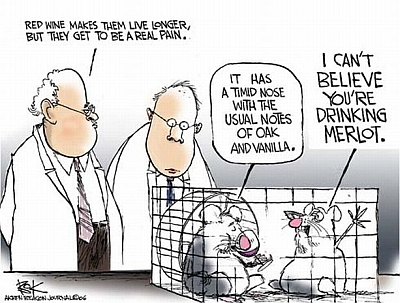
Red Wine Health Benefits Comic

Are European Producers Targeting Only U.S. Collectors and Connoisseurs?

Importing marketing, or sales professionals from Europe is a thoroughly misguided idea… unless you are trying to target the 5% of the total market (by volume) that are the collectors and connoisseurs. I have had only a few experiences with Europeans in a sales role for wineries in the U.S.  They have all been French and were the singular worst experiences I have had during all my wine trips to California over the years.

Changing the American Wine Paradigm

The challenge in the American market is convincing the average consumer that wine is not just for special occasions and holidays… or… is not just a glass on tap (yes, most winebars are now serving on tap) with friends before, or after dinner.

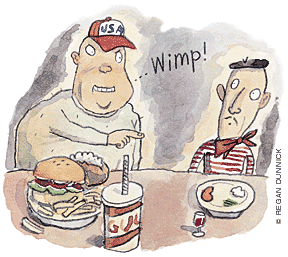
Wine Wimp

Conclusion

The more I talk to people in wine marketing in the U.S., the more I realize how misguided many are… and how absolutely correct the winemakers usually are… winemakers and vineyard managers are just farmers at heart.  It is this wine for the “regular Joe” story that resonates with the average American Consumer. If wine is to gain greater market share here, it should be experienced as relaxed and fun, with no rules. Put together an effective explanation of why focusing on wine can make life richer… and there you have a marketing campaign that will have an impact in the U.S.

Comments Off on Wine Marketing – The Gap Between Europe and the U.S.

Filed under Business, Food Pairing, Wine Industry