Tag Archives: Bordeaux

Can You Justify Spending on Premium Wines?

Okay, I know there aren’t many wine drinkers out there that maintain a diverse cellar of bottle-aged wines, but for those of you who do, and invest in the spendy, premium wines… how do YOU justify it?

Which Wines Are in Your Cellar?

2/3 of my cellar is made up of moderately priced red and white wines of good value.  The other 1/3 is reserved for more expensive, special red wines.  So, just what constitutes a “special” wine worthy of a premium price? It has taken me 20 years of collecting wine and an evolving palate to finally arrive at a couple of answers.  My justifications for spending $75+ on a bottle of wine are:

1. Wines that have structure, balance, texture, be complex, BUT ALSO be accessible in no more than 5 years, and be able to age (AND improve) for 10 years or more from the vintage date (yes, even Barolo).

That doesn’t mean the wine will be in its prime drinking window then, just that I can enjoy it and then look forward to another beautiful experience down the road.  Enjoying wines this way, requires a purchase of several bottles of a wine, per vintage.  I will rarely do this until a producer has proven a good match for my palate and been consistent with quality vintages, year over year.  Although, sometimes you just know from drinking a wine… and I say “drink”, not taste.  This has happened too many times… Tasting Room Attendant hits you with attitude, goes on and on about the wine and presses you to purchase his/her amazing $100 (speaking of Napa here) bottle.  Then, you are hit with a 1 oz. pour!  Who needs a direct relationship with a winery, when you are treated like that!  With a good experience, enjoyable wine and the right value, I will become a year-over-year customer and they can start thinking of me as a revenue source for years to come…

2. Wines that my family and friends enjoy.

An example in this category for me is expensive champagne.  Not what I personally would spend big dollars on, but I really enjoy sharing good bubbly with friends who appreciate it!

Overview

IMHO, the holy grail of wine is the 1st category.  Examples for me would be vintages of Barolo, Southern & Northern Rhone (also CA “Rhone Style”) and mountain fruit Napa Cabernet Sauvignon (Veeder, Spring, Diamond & Howell).  Yeah, I know… no classified growth Bordeaux & cru Burgundy included.  I have not tasted Bordeaux meeting that criteria under $75/btl. AND other regions bring the same level of enjoyment for $50.  ENTRY LEVEL Burgundy STARTS at $50/btl and I just don’t enjoy pinot noir enough to explore that varietal for that kind of money.  My Oregon Pinot is just fine thank you.  I have Bordeaux and Burgundy in my cellar, but just to provide a representative collection, and it skews my average bottle price more than I would like.  I know many of you DO spend that $150+/btl for Bordeaux and Burgundy.  I wonder, how do you justify devoting the disproportionate percentage of your wine budget?
2 Comments

Filed under Barolo, Bordeaux, Burgundy, Howell Mountain, Mount Veeder, Napa Valley, Northern Rhone, Southern Rhone, Spring Mountain, Wine Cellar, Wine Collecting, Wine Tasting

Should the French AOC System be Changed?

In a country where consumption of table wine is decreasing, you would think the government run wine industry (for all intents & purposes) would figure it out. There is a huge export market for reasonably priced, quality wines. Why shouldn’t the moderately priced producers in Bordeaux be allowed to use the Bordeaux name and relax the regs?

French Wine Laws Need to be Revised

As a consumer, I resent Bordeaux as a wine region.  If I want to explore the very best of Napa, I can afford it on a splurge.  The very best in Bordeaux is priced very close to insanity.  It has created a backlash with many consumers.  A perception of the damn cultural elite, dictating accessibility, creating an image that does not appeal to the average wine drinker.  It doesn’t need to be like this.  Bordeaux is at a cross-roads.  The majority of wine production in Bordeaux is actually more reasonably priced, but I rarely buy affordable Bordeaux.  With declining consumption in France, what will happen to the wine classifications Vin de Table, and Vin de Pays?  The answer should be:  allow a product geared for the export market to be developed.  Very similar to what Italy has done with the “IGT” designation.

French Wine Laws That Make Sense

I will now introduce sacrilege to the discussion… beyond the 1st-5th Growth wineries, the rest should buck the system and start a co-op outside of the AOC system and pool marketing dollars to enter new export markets.  Relax the production requirements to allow more accessible, new-world styles.  Permit label changes to make them more understandable for the typical New World consumer.  Spend money advertising  to introduce these new wines to the world… AND allow them to use the “Bordeaux” name.  

The Horror!

Why would this be so crazy?  If I had the cash to invest, I would learn French and reach out myself to get these winemakers to leave the system and step out on their own.  A group of value priced Bordeaux producers banding together and pursuing export markets outside of the limitations of the AOC system?  Wouldn’t that ruffle a few feathers?

2 Comments

Filed under Wine Critics, Wine Industry

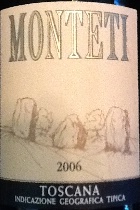
2006 Tenuta Monteti Monteti Toscana IGT

Tenuta Monteti IGT

Tenuta Monteti

Italy, Tuscany

Wine Tasting Note:

Not sure I have tasted a better bordeaux blend under $20 from any country. Nose of red plum, blackberry with slight vanilla, cinnamon and oak. The texture of this wine hits you like a ton of bricks – almost chewy. The 50% petit verdot is fantastic here. Good acidity, with medium tannins. Nice balance and structure. You can tell the fruit has begun to fade, but still has enough left to be fruit forward (must have been a bomb when young) with a big black fruit profile. I really like how this wine is totally dry on the palate, despite the fruit and vanilla. This would be a fantastic food wine for rich foods.

3 Comments

Filed under Italian Wine, Maremma, Super Tuscan Blend, Toscana, Wine Tasting, Wine Tasting Notes

Can We Make Heads or Tails Out of Wine Labels?

I am often flabbergasted at the “wine-speak” on so many labels. This is not a complete listing, just a shot over the bow at the most misused. Here is a go at cutting through the B.S.

American Wine Descriptors

Reserve

So, just what exactly are they reserving? Many wineries have you thinking this is the winemaker’s personal stash. Real meaning: this is the stuff we charge you more for, just because we can. Wineries are famous for including additional descriptors on this one, like “select reserve”, “private reserve”, or “premium reserve”.

Vintner Select

OK, would you really believe this one, if you saw it on a bottle? I have tasted wine from only one winery that uses this designation and fulfills the expectation: Pride Mountain Vineyards.

Estate Bottled

This is roughly what it says. The winery makes this wine from vineyards they own and control. The thought process here is, if the winemaker cares about the quality of the wine, he/she will watch over and tend to the quality of the fruit. While many of these wineries do produce very high quality wines, don’t count on it. There is a huge difference between a knowledgeable vineyard manager vs. a savvy winemaker.

Single Vineyard

All fruit used in the making of this wine came from one specific named vineyard. This CAN be a tool in selecting quality wines. If you track where the fruit originates in the wines you drink and you notice you consistently enjoy wines made from a specific vineyard… you just hit the veritable wine-o jackpot.

Single Block

All fruit used in the making of this wine came from one row, or section of one specific named vineyard. See Single Vineyard.

AVA – American Viticultural Area

This is the point of origin, such as the Napa Valley, Dry Creek, or Paso Robles (etc.) designation you see on the label. So guess what, only 85% of the fruit must come from that area to be referenced on the label. Here is another good one… by law in the U.S., if it says Cabernet Sauvignon on the label – only 75% of the wine must be made from that variety. The only restriction for the balance is, it must come from the same AVA. The possibilities stagger the mind.

Meritage

This applies when somebody paid the Meritage Association to use the name. For red wines, it represents a wine blended from any two or more of the following grape varieties: Cab Sauv, Cab Franc, Merlot, Petit Verdot, Malbec or Carmenere. Absolutely no implication of quality.

Bordeaux Blend

For red wines, it represents a wine blended from any two or more of the following grape varieties: Cab Sauv, Cab Franc, Merlot, Petit Verdot, Malbec or Carmenere. Absolutely no implication of quality. Geez, does that sound familiar? See Meritage.

European Wine Descriptors

Cru

A vineyard of notable quality, or specific terroir. Nothing to do with the quality of the wine. Single Cru – see Single Vineyard above.

Grand Cru

A vineyard producing an unusually high quality of fruit. Has a more specific meaning in the Burgundy region in France. See reference Beaune Committee of 1861, then forget you read it. You just have to ask yourself, who exactly is deciding this stuff? Also, just because the fruit is of high quality does not mean the wine is.

Premier Cru / 1er Cru

A vineyard producing an unusually high quality of fruit, just not as good as the Grand Cru. What? See reference Beaune Committee of 1861 and then forget it again.

1st Growth

Oh boy, here we go… best, most prestigious wineries in Bordeaux France. In reality, these were just the most expensive wineries at the time this classification was established – 1855. See Bordeaux Classification of 1855.

Be Skeptical of Wine-Speak and Make Your Own Evaluation

My guess is, at this point you have already lost interest, but for those of indomitable spirit… we trudge on with a few final comments.

By now you have probably figured out, what is on a wine label is so full of marketing gibberish, it is hard to distinguish what is of real relevance. Good luck on that one. In the U.S. vs. Europe, it is particularly a serious concern. In many parts of Europe, individual wine producing areas actually enforce practices to improve the quality of the wine from that area, unlike the U.S. with no such requirements.

I hear more and more from the industry that consumers are relying on their own tastes and making fewer buy decisions based on professional wine critics’ recommendations. In the same vein, it would be smart not to trust the wineries own professional claims printed on wine labels too! If you would like to share additional suspicious verbiage seen on a wine label, please email them to me at winedocg@cox.net.

Comments Off on Can We Make Heads or Tails Out of Wine Labels?

Filed under Wine Collecting, Wine Education, Wine Industry, Wine Tasting