
Tag Archives: American Wine Society

Devour AZ: Can Fine Dining Survive?

I recently attended the event #DevourAZ organized by #LocalFirstAZ and had the opportunity to interview several local executive chefs presenting a local mid to high tier take on the Phoenix restaurant experience. The result was a startling realization regarding new trends in the local fine dining scene.

Local First AZ (link at: https://localfirstaz.com/news) is an organization established to promote the AZ Food & Beverage industry. If you live in AZ, check out their website for other local events throughout the year. Arizona Desert Botanical Gardens in Phoenix, AZ (link at: https://dbg.org/) was closed for this private event. Great garden venue and a perfect choice for eating and drinking in an enjoyable, relaxed setting. DBG was a great place to enjoy the temperate AZ winter weather and discover new favorites on the AZ food & beverage scene. There were lots of prepared local foods with wine, beer and spirits showcasing Arizona restaurants, distributors and beverage producers. This event was sold-out well in advance, so if you are interested in attending next year, make sure to buy tickets early.
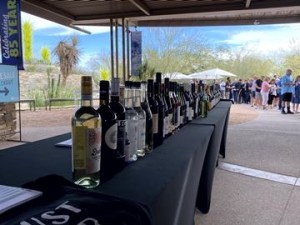
Loads of wine, beer and spirits to taste.

THE INTERVIEWS

All four chefs I spoke to, shared the same two-part message: a reasonably priced fine dining experience is now beyond even the upper-income dining community and younger generations are significantly changing their restaurant preferences. As a Boomer generation diner, I am accustomed to a white tablecloth, multi-course, curated food & wine experience. If you are of the same mindset, be prepared… it is all changing.

POST-COVID PRICE CHALLENGES

One of the more well-known curated fine-dining restaurants in my area is Monarch Cafe in Scottsdale. I checked their most recent menu and the per-plate cost has risen to $150-$250 per plate, plus beverage. A friend recently told me he dropped $1,000 on a recent Monarch visit for two with a pre-fixe menu, two bottles of wine and tip for the evening. He doesn’t plan to go back any time soon… There are choices in Phoenix that can get you near the experience for $500-$600, but it is a compromise. There is only one traditional fine-dining restaurant left in Phoenix that allows you to bring your own wine for a corkage fee. These prices will significantly limit the pool of potential clients for this category of restaurant and is pushing those restaurants still trying, to either close their doors, or change their menu, service AND business model.

The issue for restaurants and bars during COVID was just finding help. Now, it is making a new business plan work with huge increases in competitive wages and on-going service inflation. None of the chefs I spoke to were investing in significant server training and all were trying to find a simpler approach to a menu that did not require lengthy explanations of flavors and pairings to sell the experience. They all said servers in this market with the needed experience/knowledge to offer a traditional fine-dining experience are now at $60K-$75K/yr. income level with salary and tips… and are disappearing. Add 25-50% to that for the major centers of fine-dining like San Fran, Chicago and New York.

CHANGES IN BEVERAGE

Wine prices have continued to move higher in the U.S., having been the most expensive dinner beverage option for some time now. This has been my pet-peeve for years. With wineries moving towards the premium category for more than a decade AND the total lack of interest exhibited by volume producers to offer decent quality at lower price points… the entire U.S. industry has been shooting itself in the foot… as percentage wine consumption is dropping by double digits. The industry will lose entire generations of wine drinkers at this rate. In Italy, Germany and France, a $20 USD carafe of red wine at a restaurant competes on quality favorably with the $40-$50 bottles of U.S. wine I have purchased at restaurants.

These factors are causing the chefs I interviewed to cut their wine & craft beer (yes, beer consumption is now dropping too) inventories in half and move towards craft cocktail programs. Cocktails don’t require premium spirits brands, spoilage is a minimum, is a much smaller investment and can offer a very diverse flavor spectrum with little effort… and is much easier for untrained servers to support.
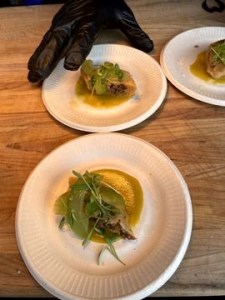
Bites from numerous restaurants serving many different dishes/flavors.

CHANGES IN MENUS/FOOD STYLES

The younger generations seem to be less interested in a 3-4 course traditional meal, than they are in a multi-plate, tapas-style experience. I understand that this approach can offer a more diverse flavor spectrum, but it totally ignores the idea of curating flavor and beverage pairings. For any of you that have had formal training, this is anathema to the old-world European style experience. European cuisines have experienced generations of being honed to find the most complementary flavors and beverages. Millions have been spent on promoting complimentary local food and beverage styles that are identified with a specific location, or region.

There is the service aspect here too. These chefs told me they can compose tapas style menus that describe simpler single flavor profiles that don’t require a trained server to explain. This approach offers a lower payroll cost, corresponding to a lower bill at the end of the meal.

FUTURE OF FINE-DINING

I have been mourning the loss of fine-dining in Phoenix for a couple years now and wracking my brain to look for alternatives to showcase curated food and beverage at a reasonable price. This is what I have come up with and I would appreciate your feedback.

I first thought that the American Wine Society (link at: https://americanwinesociety.org/) was the answer, but there has been significant push-back on including the idea of curated menus with wine tasting. I am hoping this myopic view of wine will change and the leadership will recognize how important food is to the wine experience. I still have hope this is possible and am continuing my efforts to move local AWS chapters in this direction.

I have begun building PowerPoint templates to assist inexperienced enthusiasts in effectively hosting curated food & wine experiences in their homes. If we are going to save the idea of pairing flavors and beverage in the dining experience, it may be possible to do this 8-10 people at a time, with a private experience in local homes. Would there be enough interest to build networks of small groups with this theme in mind? I am hoping…

2 Comments

Filed under Fine Dining, Food Pairing, Restaurant, Restaurant Review, Sommelier, Spirits, Wine Education, Wine Industry, Wine Marketing, Wine Tasting

Wine Scoring Systems: What You Need to Know

The Scoring Systems

Three systems are most commonly used for wine scoring today: Robert Parker’s 100 Point System, UC Davis’ 20 point System and the Gold-Silver-Bronze Medal designations. So, let’s dive into each and understand their components, focus and determine their real-world reliability.

UC Davis & Medal Scoring Systems

Often, these two are tied together.

Medal System:

  • Gold-medal:     18.5–20.0 points – Outstanding quality
  • Silver-medal:   17.0–18.4 points – Excellent standard
  • Bronze-medal: 15.5–16.9 points – Very good wine for its class

UC Davis System:

  • 17 – 20  Outstanding
  • 13 – 16   Standard wines with no defect
  • 9 – 12     Commercially acceptable with no defect
  • 5 – 8       Below commercial acceptability
  • 1 – 5       Completely spoiled
  1. Appearance (2 points)
  2. Color (2 points)
  3. Aroma and Bouquet (4 points)
  4. Total Acidity (2 points)
  5. Sugar (1 point)
  6. Body (1 point)
  7. Flavor (2 point)
  8. Acescency (Bitterness) (2 points)
  9. Astringency (Tannin) (2 points)
  10. General Quality (2 points)

The glaring missing pieces are Balance, Complexity, Finish and Age-Ability. Without these factors, fine wine cannot accurately be judged. The UC Davis System has an inherent bias toward poor to mediocre wines. The problem is the potential for a 16 pt. score (bronze medal) for a typical Concord sweet wine, in comparison to a 16 pt. score for a mediocre Mendocino Cabernet Sauvignon. The latter is eminently more drinkable, yet carries the same score. This system allows too much weight for components that would be assumed with fine wine, such as Appearance and Color and virtually none where fine wine shines, such as Balance, Age-ability, etc. This evens the playing field for amateur wines and narrows the gap between the professional and amateur wine categories. BEWARE of medal designations and UC Davis scoring. If you enjoy fine wines and in particular, if you collect Old World wines, this scoring system is not for you.

Parker’s 100 Point System

  • 50 Points for Showing Up 🙂
  • 5 Points for First Impression or Color
  • 15 Points for Aroma or Bouquet
  • 10 Points for Flavor
  • 10 Points for Finish
  • 10 Points for Aging Potential

OK, this has its problems too. Certainly not scientific, or very systematic, but it weighs the important characteristics of fine wines. This too is missing the balance and complexity components, but allows enough latitude to score (let’s say) a U.S. 1997 Robert Mondavi Private Reserve Cabernet Sauvigon versus a French 2000 Chateau La Gaffeliere. Something the UC Davis and Medal systems do not.

Frankly, this system will just not work for evaluating an amateur winemaker’s sweet 2017 Chambourcin (native hybrid grape), BECAUSE Old World style wine quality is in another category of its own. So far removed, that any 20 Point System equivalent would require adding decimal quantifiers (i.e. 19.1, 19.2, etc.) to attempt to make an equivalency work.


5/28/18 – I have had a few comments from those who follow my blog about not including the WSET “Systematic Approach to Tasting Wine”.  I have never seen this system used by a wine writer in their media product (although some components are similar to UC Davis system). I am not sure it would/could be a commercially viable solution. I would appreciate any feedback on this, though. I am sure there are some that are using it in the background and converting it to the more common scoring systems (WSET Graduates your thoughts?)


A ” Wine Judge Certification Program”

This year I had an interesting experience with a wine judge training/certification program (Wine Judge Certification Program – WJCP) run by the American Wine Society (AWS). There are very few programs like this, specifically certifying wine judges in the U.S.

This program introduced me to a whole new subset in the wine continuum: amateur winemakers, native grape species and fruit wines. It became very clear to me quickly, AWS has a significant piece of their membership focused on this area. In fact, they have changed the UC Davis scoring system to make it more internally friendly to these wines. I also found out, there are many wine competitions across the Eastern half of the U.S. specifically focused on these type of wines. Who knew!!

Full Disclosure: This focus seemed quite odd and I could never get my head around it. I did make the decision to stop investing in these classes and have since exited the program.

I had never seen a bottle of anything in this category, before these classes. My closest familiarity was the Mogen David Concord wine my parents drank over ice occasionally. Who knew there was a whole wine culture that focused on this type of wine. I still remember the worst hangover of my life from drinking 3 bottles of Annie Green Springs when I was a teenager. I suppose someone has to evaluate these wines, but using the same scoring system to evaluate an aged Napa Cabernet Sauvignon is nothing but tragic. What happened to the idea that wine and local cuisine is a match made in heaven? Certainly, not with these wines.

The Jumble and Ambiguity of Wine Scoring

If it hasn’t become clear yet, there is an enormous amount of confusion surrounding these scoring systems. So, how can we use them to choose wines to match our tastes? Personally, I ignore the 20 pt. and Medal Systems completely and I take the 100 pt. System scores with a grain of salt… unless I am familiar with the judges palate. For example, I have a pretty good idea of what these wine writers/judges rate highly: Parker, Suckling, Galloni and Tanzer. I can make a reasonable guess at quality from 100 pt. system scores generated by these wine writers.

So, what do you do? Well, if you are a fine wine drinker, I would surely ignore the 20 pt. and medal systems. From there, it is all homework. Get to know what your favorite wine writers tend to score highly, learn their palate a bit and use their scores to make your choices!

P.S.

If I could develop my own scoring system for the wines I drink, it would be a version of a 100 pt. system and look something like this:

  • 5 Points for First Impression or Color
  • 15 Points for Acidity
  • 10 Points for Tannin and its Texture/Mouth-Feel
  • 15 Points for Aroma or Bouquet
  • 10 Points for Flavor
  • 10 Points for Finish
  • 15 Points for Balance
  • 10 Points for Complexity (mid-palate & layered flavors)
  • 10 Points for Aging Potential

A red wine theoretically could have a perfect score of 100. White/rose wine with no tannin would have 90 as a perfect score. Without balance, complexity and aging potential, 35 points are lost! With this type of system you could easily get the point swing needed to separate amateur wines from bottle-aged fine wines.

Many of these components are too subjective to make it onto a judges sheet at an amateur wine competition. The focus there has to be on the basics: no faults, or objectionable components. How many people get to formally judge better wines anyway? Only a lucky few…

7 Comments

Filed under Wine Collecting, Wine Critics, Wine Education, Wine Industry, Wine Marketing, Wine Tasting

The Future of Wine Marketing?

Premium Branding and Targeted Marketing

Market Research

I try to spend time occasionally researching wine consumption and how those trends affect the industry. Along that line, a couple of media items came to my attention this week. This article published by Beverage Dynamics on current wine trends at – https://bit.ly/2JZ1cjp and the NPR Radio program regarding the history of Grey Goose brand Vodka and Jagermeister brand liqueur at – https://n.pr/2Fk3ZEg. Take a look for some background, or just follow along below. I will do my best to take you through the impressions this left with me that caused my view of wine marketing to veer in a very different direction.

2017 Wine Trends

This Beverage Dynamics piece lists:  the largest selling wine labels in U.S. by volume, their growth in the last year and the fastest growing labels coming up. So, I am reading through this piece and it occurs to me – with over a 600 bottle personal cellar, I don’t have one bottle of any of the labels mentioned. Not one! Why is that? I am sure some of these are decent daily-drinking wine. Not everything in our cellar is expensive wine. Why hadn’t I found one of these as a daily-drinker for my enjoyment? Had me thinking. Then I listened to this radio program…

Guerrilla Marketing & Beverage Industry

It appears Sidney Franks (of Grey Goose Vodka fame) was the original mastermind behind the concept of “guerrilla marketing” in the premium beverage business. Relative to the Jagermeister brand, he took a product enjoyed in the USA by old German guys, and gave it a new hip, young and fresh make-over. This very successful re-branding effort was accomplished by sending out young, trendy brand ambassadors to college bars to promote the product face-to-face. Wow! Grass-roots demand generation from the ground up! It is hard to believe such a simple idea built a brand in U.S. with over $500M+ in revenue.

Wine Marketing

Hang in there with me… So, I am thinking about the wine labels from the Beverage Dynamics piece and I realize, I can’t remember a single piece of advertising regarding these brands! Broadly distributed, high-volume labels don’t register on my radar. Not because I am a snob, just because these wines tend to be homogenized. All much alike – very drinkable, but without much character. I tend to tune out products that I don’t believe will be of interest… there it is: “will be of interest”. How does my brain decide what wine information should be filtered out? Even more interesting, what would it take to grab and hold my interest? Fodder for another piece down the road…

Wine Collectors

It took me over ten years to find a group of guys that collect classic premium wines in the Phoenix Metro area. It always struck me, why was that so difficult? What organization in the wine industry identifies the individual market segments and brings like-minded consumers together? I was thinking at least one producer would attempt to do this to promote their product and build demand. Nope. Nada. Nothing. How is that possible? I did find an organization a couple of years ago that I thought might be the answer: the American Wine Society, or AWS (http://www.americanwinesociety.org/). It didn’t work out at the time. The chapters in my area were focused on typical, easy drinking, lower price wines. After some investigation, I just lost interest. Then recently I ran into Jay Bileti (an officer at AWS) and he “listened”. The net result was gleaning out of the current membership a few folks whose interests leaned in this direction. Voila!, we had a wine collector’s tasting group. The point is: where is the industry involvement? It is becoming increasingly clear as the baby-boomer generation ages, marketing must become more focused, target specific price categories and connect with consumer interests. Implementing a little of that “Guerrilla” thinking and investing in filling this gap would have a huge impact on label/brand awareness. Add a few smart folks to the mix and you would have the next great Sidney Franks-like story in the wine business!

Wineries & Marketing Investment

The first simple idea would be for wine producers/marketing reps to reach out to consumer organizations like AWS. No, not the way it is done now, but to invest in surveying wine enthusiasts to identify consumer market segments, categorize interests, separate price categories, build palate profiles and associated taste models. THEN, provide services to connect individuals. The best marketing ideas build a COMMUNITY! This is where brand loyalty begins. Right now, none are willing to invest this way, because there is no vision for how to monetize it. This has to be the future for premium brand wine marketing as Boomers age. Just holding local wine tastings and wine dinners is not the full answer. I wonder, what would it take for a few producers to embrace this idea?

1 Comment

Filed under Business, Wine Collecting, Wine Education, Wine Industry, Wine Marketing